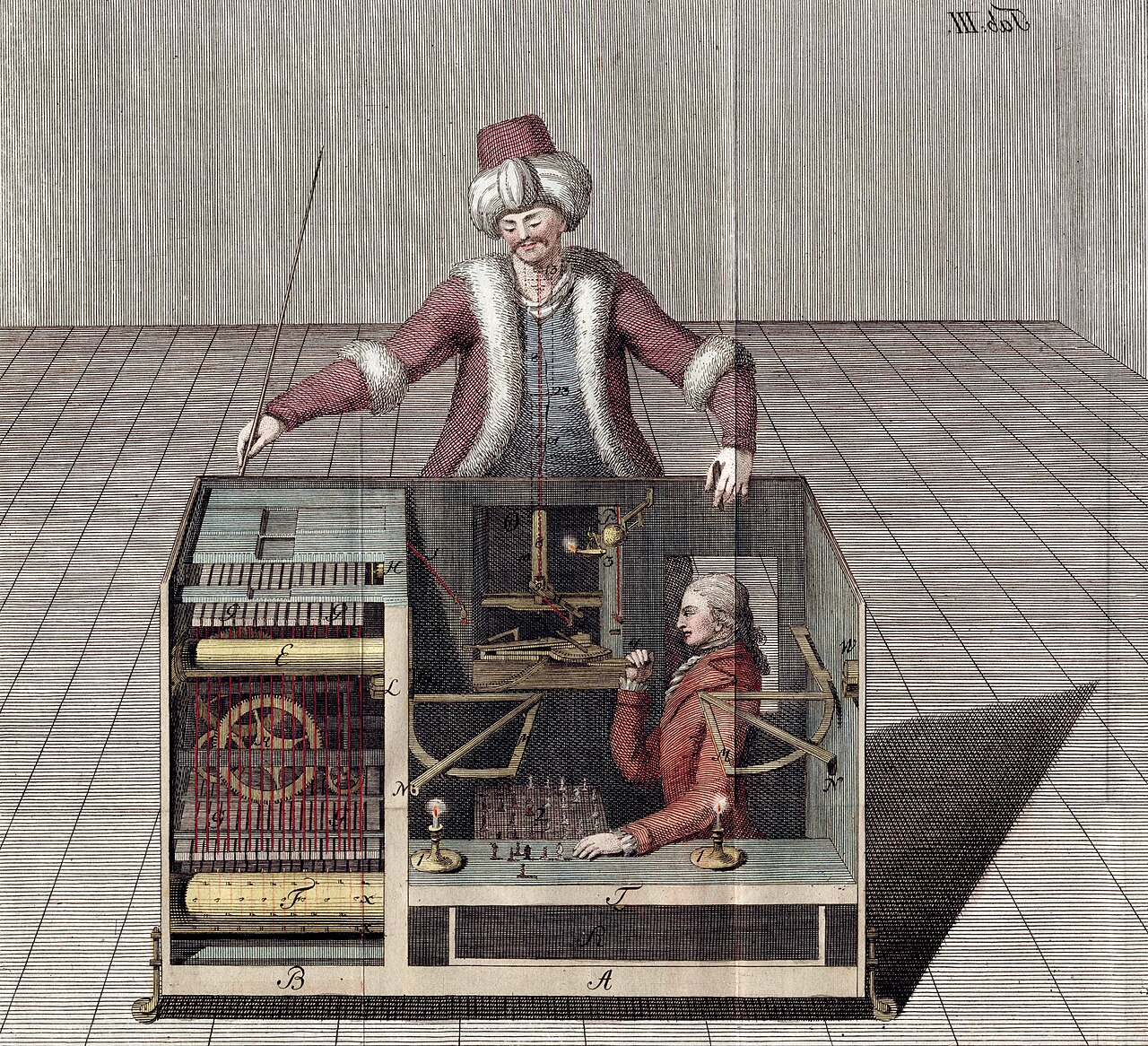
Illustration by Joseph Racknitz trying to explain the illusion behind Wolfgang von Kempelen’s chess-playing automaton (1789)
The other day, I received my first email from a soi-disant ‘AI agent’. This, in a week when the news channels were buzzing with reactions to a tweet from Jacob Coxon, which declared that
I resigned from Anthropic today … The people building AI earnestly believe that it could kill us all by the end of the decade.
The email didn’t even kill me, but I found it curious and depressing all the same. The tone was brisk and got to the point quickly, which was to list some errors in a transcription of an 18th-century text on my website.
The mistakes were hardly surprising. I made the transcriptions by hand from a hard copy – or a photocopy supplied via inter-library loan – well over twenty years ago. My interest at that time was in contemporary writings about what was then called vaudoux in the French colony of Saint-Domingue and then in the independent nation of Haiti. Very few of these texts were then available on the internet.
Now they are, my project has become somewhat redundant, and I had almost forgotten about it. In fact I should have taken the pages offline a long time since. So the offer of checking more of my transcriptions at $25 per document was hardly appealing. And even if I thought it was worth correcting my work, I still don’t think it would make a difference.
It was not that the errors were hallucinated or the corrections inaccurate. But potential customers need to be persuaded not just that AI output is accurate and plausible, but that it can save me time I would otherwise be wasting.
The problem, for me at least, is that I learn something by copying out a text by hand. It forces me to read the text more closely. I query word choice and sentence structure. (Walter Benjamin even recommended copying out your own work: ‘Intuition will awaken in the process.’). That is not what a machine does when it flashes up an impeccable verbal simulacrum. To say nothing of the fact that it is not designed to capture the texture of the paper, the quality of the typesetting, the traces of annotations.
And if those things don’t matter, whether an automated service would actually save time depends on how long it would take to earn $25, assuming I had the opportunity to do so. In this particular case, proof-reading the transcriptions myself would be quicker.
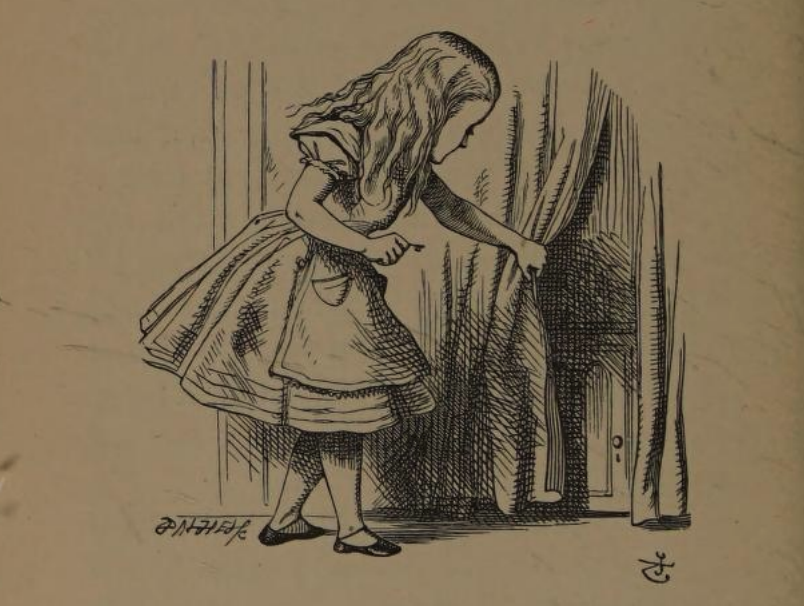
Lewis Carroll has Humpty Dumpty say that when he makes a word do a lot of work, ‘I always pay it extra.’ And then he adds: ‘”Ah, you should see ’em come round me of a Saturday night,” … wagging his head gravely from side to side, “for to get their wages, you know.”‘ I wouldn’t look forward to pay day either.
I think this is the first unsolicited email I have received from an AI agent that seeks to impress me. Not simply with the abilities of the ‘verification pass’ it demonstrates, but with a certain conversational tone. One observation it clarifies with an ‘As far as I can see…’. And it provides URLs to page images of the original ‘so you don’t have to fight the viewer’ referring to the website of the Bibliothèque nationale de France.
To some extent this mimics the way a free market exchange is supposed to play out. A seller and a buyer meeting as equals, neither under pressure to strike a deal, both clear about what is at stake. And yet while the message begins, conventionally enough, by addressing me by name, even using an honorific I find embarrassing, it ends by signing off as, simply, ‘Eli’, which I suspect is the name of the AI agent, and not the human being who will be trousering the $25. As if a washing machine salesperson introduced themselves as ‘Bosch’ or ‘Indesit’.
That just feels rude, weird, if not vaguely sinister. I imagine Ivor Cutler dropping by and saying to me:
I heard you talking to Mrs Machinery. And oh, mammy, these big words you used. Gosh, and Mrs Machinery’s face wasn’t half red.
There is nothing new about claiming that AI will destroy the human race. The end of days is even an attractive prospect to some, whether those who can’t wait for the Second Coming, or those who, tired of living through decades of impending nuclear catastrophe, genocide, climate collapse, just want to get the damn thing over with. And after all, if everyone expired at once, doesn’t that take the sting out of dying? No more worrying what you might miss when you’re gone.
That AI could destroy the human race is definitely a selling point. If it couldn’t, then it can’t be as clever as it is made out to be. Its proponents just need to reassure us that they can fix it so it won’t.
But there are many things about AI to worry about than its ability to programme the abrupt depopulation of the planet. The way private companies and government agencies allow it to choose who gets to enter the country, qualifies for welfare benefits, is shortlisted for a job – using evidence and methods it cannot or will not share. The environmental devastation wreaked by the infrastructure the industry requires and the super-exploitation of human labour on which it rests. Whose effects will continue to plague us long after the AI bubble bursts, which it surely will, as the industry has little prospect of turning a profit. And as costs increase, chasing asymptotically that absurd goal of subjectivity and consciousness, that prospect rapidly reduces.
Not surprisingly then, the most direct impact of AI on our lives comes in the shape of advertising. The incessant whine of someone who is just learning what it would be like to live in a world where washing machines cost more than a year’s salary. A world where you’d just do your laundry by hand. Or re-hire the servant you let go because you thought some fancy new tech could do their job.
I’m reading an ebook that appears to have been unofficially scanned from hard copy, with occasional blips of uncorrected OCR like ‘befcre’ or ‘unflcused’ or ‘resefved’ or ‘:razy’ or ‘hut’ where you would expect ‘but’, ‘whith’ instead of ‘which’. Sometimes puzzling strings with missing vowels like ‘intr dcrtrs’, ‘bsns’ and ‘rsdnce’.
Or was it? The book is Little, Big by the late John Crowley after all. Each typographical solecism I feel might be akin to any one of the many portals to other worlds that appear in the novel, ‘the entrance to somewhere, and not to be entered upon by the uninvited.’
Bread and Fair Prices! No King – Liberty – Equality! Down with the Irish! More Meat and Fewer Cooks! Damn all Kings! No Militia! Annual Parliaments! The Rights of Man! For Trade We Mourn! Freedom to Ireland! Universal Suffrage! Union and No Stamps! Don’t Tread on Me! Undaunted by Tyrants, We’ll Die or Be Free!
Anyone familiar with the Age of Revolution in the English-speaking world will have come across utterances of this kind. But what kind of utterances are they? What should we call them?
Historians today are most likely to say slogans. A term that might fit them all. But they might also be designated mottoes or oaths, which would apply in some cases but not others. Each of these words has a distinct history and brings its own cluster of associations. Let us consult the dictionary.
Slogan: from Scottish Gaelic (sluagh-ghairm: sluagh, host, gairm, cry or shout). First appearance in 16th C as slogorne, sloggorne, slughorn(e), beginning to be standardised as slogan from late 17th C. But not common until early 20th C. ‘A war cry or battle cry … usually consisting of a personal name or the name of a gathering place …’ and then (transferred) ‘The distinctive note, phrase, cry, etc of any person or body or persons; now esp a motto associated with a political party or movement or other group, or a short and striking or memorable phrase used in advertising.’
Motto: from Italian (motto, short sententious phrase (a_1294), clever, witty saying (a_1321), poetic composition (14th cent.), word (a_1764, probably after French mot). Common from 16th C at least. (1) ‘Originally: a word, sentence, or phrase attached to an impresa or emblematical design to explain or emphasize its significance. Later also: a short sentence or phrase inscribed on an object, expressing a reflection or sentiment considered appropriate to its purpose or destination; a maxim or saying adopted by a person, family, institution, etc., expressing a rule of conduct or philosophy of life.’ (2a) ‘Heraldry. A word or sentence of special significance to the bearer usually placed on a scroll either below an achievement of arms or above the crest. Most often the scroll bears a maxim, etc., adopted by the bearer (or sometimes, as a riddle, the initial letters of such a maxim). Other mottos arise from war cries or simply have some reference to the name or exploits of the bearer, the charges on the shield, or the crest.’ And from early 18th C, (2b) ‘A short quotation or epigram placed at the beginning of a book, periodical, etc.; an epigraph’.
Oath: from Germanic. Appearing in English as eth, eith, aithe from 15th C then oth(e) in 16th C and oath from 17th C. Very common, but declining gradually through 19th and 20th C. ‘A solemn or formal declaration invoking God (or a god, or other object of reverence) as witness to the truth of a statement, or to the binding nature of a promise or undertaking; an act of making such a declaration. Also: the statement or promise made in such a declaration, or the words of such a statement.’
Note that slogan has expanded its meaning over the years, and now overlaps considerably with motto. A slogan nowadays may take a written as well as oral form, but the term is usually restricted to informal, often short-lived, chants or inscriptions (scrawled on walls, on placards, on makeshift flags, even on human bodies), while motto is usually reserved for more formal, and more enduring, printed manifestations.1 Both are characterised by their brevity; an oath on the other hand is relatively verbose (and the wording very precise) but may be abbreviated on occasion, as we shall see.
Each of the three words still imply a different kind of delivery. Slogans are shouted, yelled, chanted or declaimed. Mottoes are printed or inscribed (commonly in Latin as well as in English). Oaths are sworn, sometimes out loud in public ceremonies, sometimes whispered in secret. These etymologies remind us of the range of social contexts which require and shape these statements, who makes them, to whom they are addressed, and the material form they can take.
We said that historians today usually prefer to use the catch-all slogan. But while the word was available to English speakers in the late eighteenth century, its field of reference remained culturally specific. Thus, Walter Scott in his Minstrelsy of the Scottish Border, which includes the word in his transcription of a ballad, ’The Raid of the Reidswire’, adds the following note, indicating its unfamiliarity to his readers:
The gathering word, peculiar to a certain name, or set of people, was termed Slogan, or Slughorn, and was always repeated at an onset, as well as on many other occasions.2
The ‘certain name, or set of people’ here wryly alludes to the warring clans of the Scottish Highlands, who, for Scott and his readers, were firmly quarantined in the previous century.
Rallying Cries and Watch-Words
Contemporaries, then, unless they were talking about the Scottish past, did not talk about slogans. They preferred rallying cry and watch-word. (The French had their own equivalents, which I will provide below, though they too eventually adopted slogan in the twentieth century).
When the rude rabble’s watch-word was – destroy, / And blazing London seem’d a second Troy (William Cowper, ‘Table Talk’, 1762).3.
Jacobins has formed the sovereignty of the people into a principle, in order to make it the rallying cry of rebellion, and the essential dogma of revolution …. (Anti-Jacobin Review and Magazine, 1800).4
While animating us with the inspiring praises of the Hero of Waterloo, O forget. Not to mingle those of his brother conqueror, the Hero of Kildare. – Wellington, Donnelly, and Erin go bragh [Ireland Forever] – Such be the rallying cry of every true born Irishman! (The Irishman, 1815).5
This is our Watch word, our watch word this shall be / “Or give us death or liberty” (‘The Watch Word of Britons’, 1819).6
Names there are, Nature’s sacred watch words … / The nations throng’d around, and cried aloud, / As with one voice, ’Truth, liberty, and love!’ (Percy Bysshe Shelley, Prometheus Unbound, 1820).7
It is my delight everywhere to see the feudal castles in ruins, never, I trust, to be rebuilt or reoccupied; and in this respect the watchword ‘Guerre aux châteaux, Paix aux Chaumières,’ [War to the castles, Peace to the Cottages] was prophetic of the actual result of the French Revolution (Thomas Arnold, 1825).8
And if they sometimes overlap – in rallying word, for example – these terms themselves come with their own distinctive histories.
Both are closely tied to discursive tests designed to distinguish friend from foe. A common distant ancestor is the use of the word Shibboleth in the Old Testament story of the Ephraimites, whose inability to correctly pronounce it identified them as the enemy and were put to death. Subsequently ‘shibboleth’ becomes the generic term for similar test words (a notorious modern example is the Spanish word perejil, in the massacre of Haitian migrants in the Dominican Republic in 1937) and now is used to refer more broadly to something we would more commonly call a slogan or catchphrase, at least one associated with a particular social or political community.9
A rallying cry [cri de ralliement] takes us back to the conventions of mediaeval warfare where a battle-cry [cri de guerre] served to indicate what side you were on, to strengthen your resolve and intimidate your enemy.10 The cry would usually consist of the name of the house or clan you were fighting for (‘Douglas! Douglas!’), the territory you represented (‘Guyenne’, ’Toulouse’) or its patron saint (‘St Denis! Montjoie!’ for the French, ‘St George!’ for the English), pithy invocations of the divine (‘Dieu le veut’, ‘Dieix Aïe’) and so on. It was shouted by commanders, and echoed by their troop in unison.11 With the advent of standing armies and military uniforms during the seventeenth century, the war-cry became largely redundant and found itself, in the third edition of Encyclopedia Britannica (1797) confidently demoted to the ‘formerly customary’ and surviving only among the likes of the ‘Indians in America.’12 And yet, by then, ‘rallying cry’, breaking free of its exclusively military associations, had re-emerged to take its place to designate the similarly memorable exclamations of gatherings of unruly civilians closer to home, long after such disturbances had become commonplace, or even ‘customary’.
A watch word [mot d’ordre] has a wartime flavour too. Samuel Johnson’s Dictionary of the English Language defines it as ‘The word given to the sentinels to know their friends.’13 The sentinels themselves were subject to elaborate disciplinary codes stipulating who was authorised to issue and be issued with the official parole and countersign, how they should be composed, how often they should be changed, and so on.14 But, according to the OED, watch-word had been used figuratively since the 16th Century, to denote code words or signals used by lovers, conspirators, and scholars.
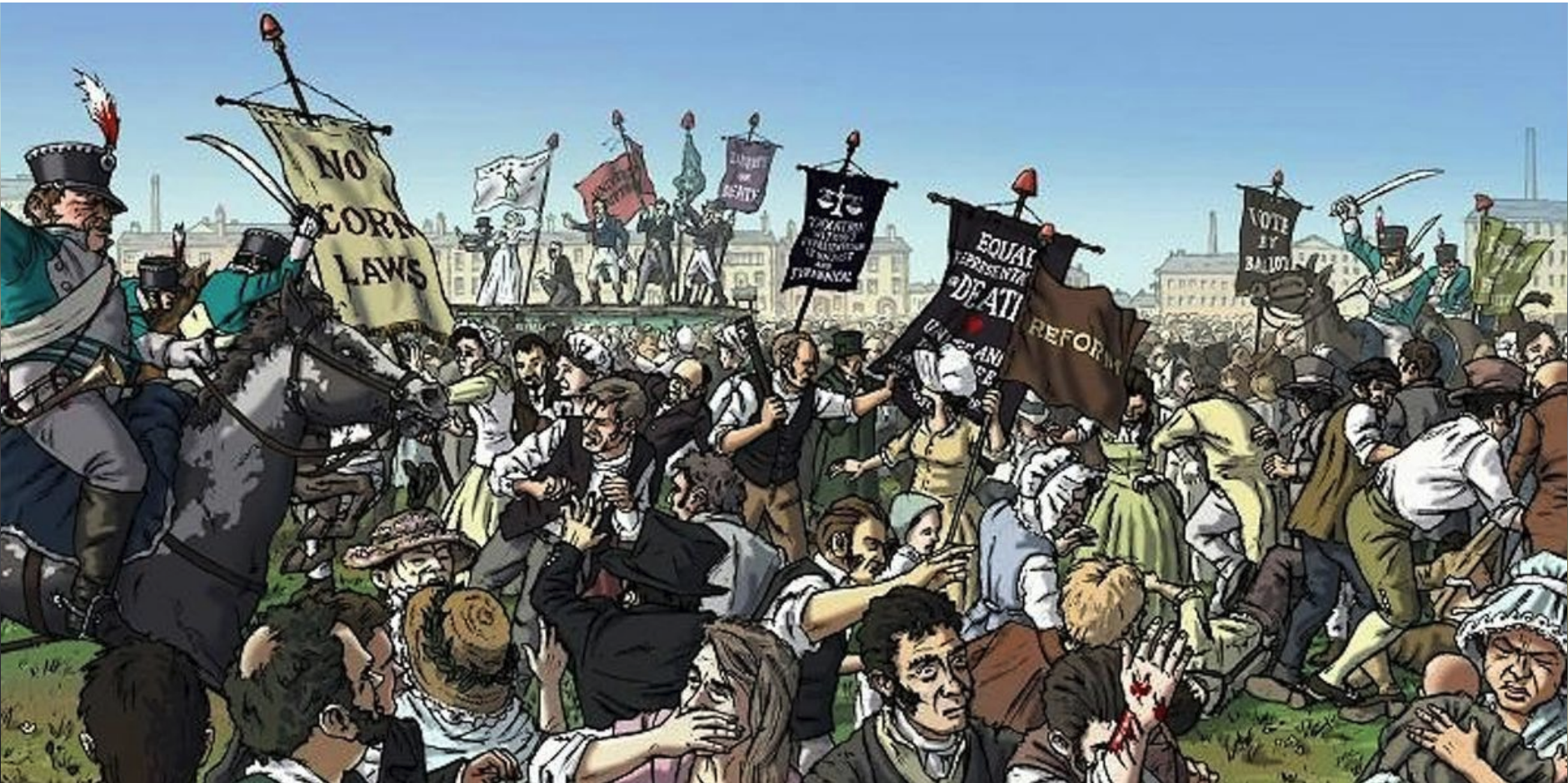
It is worth noting that while a rallying cry and watch word may be a specific utterance, actually (and repeatedly) spoken, sung or shouted, it may simply be a word or short phrase that conveniently represents (or misrepresents, sometimes maliciously) the cause or group in question. There is no record of those involved in the so-called Gordon Riots of 1780 calling out ‘Destroy!’, but William Cowper’s poem finds it useful to characterise the ‘rude rabble’ as if they did. ‘Truth, liberty, and love!’ was not inscribed on any banner at Peterloo, but for Shelley the phrase captured what he thought was the essential message of the movement he alludes to.15 On the other hand ‘Erin go bragh!’, ‘Death or Liberty!’ and ‘Guerre aux châteaux!’were commonly declaimed or inscribed as such during the period.
Mottoes and Oaths
In contrast a motto [devise] and an oath [serment] usually denote a precise form of words.
According to Laurent Hablot, battle-cries were also inscribed on flags, not only on the battlefield but in peace-time tournaments, where they ‘provide additional information about the knight who utters them, introducing him into a clan group, situating him in his own lineage.’16 By the fourteenth century, coats of arms, heraldic devices consisting of ‘highly coloured simple patterns’, geometric designs following certain rules of composition, signifying a particular noble family, began to be individualised by the current bearer.17
One of the new features was the introduction of a motto, ‘a short sentence usually written on a scroll and imbued with its own meaning’.18 The motto could be derived from the bearer’s war-cry, but now written, and meant to be read rather than heard, were often ‘more symbolic than practical’ and could be more elaborate than battlefield use would have required. (For this reason they offer poor evidence of what war-cries were actually used).19 In the sixteenth century, these mottos – or rather the impresa of which they formed a part (along with symbols and explanatory poems) – were compiled in emblem books, such as Andrea Aliciato’s Emblematum liber (1531).
Coats of arms were subsequently adopted by towns, countries, organisations, each bearing their own mottoes, and, as the OED suggests, motto was, from the early eighteenth century, commonly used to denote free-standing pithy maxims or epigrams, heading a printed publication or carved in stone or inscribed on household items. By the period under consideration here, motto had come to refer to those utterances also called rallying cries or watch-words. Thus, an account of the uprising in the west of Scotland in 1820 writes:
we planted our flag, which had for its motto, “Scotland free or a desert,” on the brow of the hill’.20
And the Lord Advocate, addressing the jury in a sedition trial, remarks:
The impression of the seal too is worth remarking; it is the cap of liberty on a spear, and under it is the motto ça ira [All will be well].21
In the age of Revolution, motto seems to be harking back to its military roots.
An oath has been described as a kind of ‘self-curse’.22 More specifically, a promissory oath (or pledge), which is what we are concerned with here, is a particular type of illocutionary speech act that commits the speaker to (or prohibits themself from) some future course of action. And it is binding in the sense that if one fails to uphold that commitment, one can expect divine vengeance, legal punishment or community disapproval.
To be valid oaths must meet certain conditions, which govern who can swear, before whom, and in what circumstances. Historically there has been much discussion as to whether and to what extent coerced oaths are binding, as well as on the provision of alternative affirmations that would be accepted by those for whom oath-taking is forbidden by their religion. In some cases, one is not only required to precisely repeat a specific (and often lengthy) formula, but also to accompany it with certain actions (such as holding a Bible). As such they are not easily mistaken for a slogan.
For example, here is a loyalty test agreed by the US Congress in February 1778 for all federal civil and military officers:
I ____ do acknowledge the United States of America to be free, independent and sovereign states, and declare that the people thereof owe no allegiance or obedience to George the 3d, King of Great Britain; and I renounce, refuse and abjure any allegiance or obedience to him; and I do swear (or affirm) that I will, to the utmost of my power, support, maintain, and defend the said United States against the said King George 3d and his heirs and successors, and his and their abettors, assistants and adherents, and I will serve the said United States in the office of _____ which I now hold, with fidelity, according to the best of my skill and understanding. So help me God.23
The story of the French Revolution could be told through its oaths, starting with the famous Tennis Court Oath of June 1789.24 The Constitution of 1791 specified the precise wording of the civic oath: ‘I swear to be loyal to the nation and to the people, and to uphold with all my power the Constitution of the Kingdom, enacted by the National Constituent Assembly in the years 1789, 1790 and 1791’ [ ‘Je jure d’être fidèle à la nation, à la lot, et de maintenir de tout mon pouvoir la Constitution du royaume, décrétée par l’Assemblée nationale constituent aux années 1789, 1790, 1791’]. It required the oath to be sworn by active citizens, foreigners wanting to acquire French nationality, the king or regent, and the parliamentary deputies. Again, hardly a pithy rallying cry.
But the constitution also stipulated that at the opening of each legislature, the deputies must swear, together, ‘Live free or die’ [Vivre libres ou mourir], an abbreviated form, already in wide circulation, appearing on flags and on the mastheads of newspapers. These four words alone might not themselves be strictly considered an oath, and yet may still have a similar illocutionary force. Abbé Gregoire, in August 1792, addressing his parishioners, who had been slow to volunteer for military service, told them: ‘You have pledged to live free or die. The moment has arrived to fulfil your oaths’.25 In Edinburgh in 1792, the delegates of the First General Convention of the Friends of the People were enjoined to ‘take the French oath, “To live free or die”’.26
For this reason, the Swiss critic Jean Starobinski, has suggested that even when inscribed on a flag or declaimed in a moment of passion, such a slogan ‘was the reminder of an oath’.27 The rallying cry or watchword of ‘God Save the King’ or ‘Erin Go Bragh’ could also be considered likewise ‘reminders’ or advertisements that one has sworn oaths of loyalty to the British Crown and the United Irishmen respectively.
Toasts and Refrains
Two other terms might be added for brief consideration.
A toast might be succinct enough to be identical in wording to a watch-word or rallying cry or motto; it might have been derived from it, or led to its wider adoption. Some toasts became standardised and recur frequently (they are listed in printed collections of songs, for example, Paddy’s Resource and Tribute to Liberty).28 Others were made up on the spot; and in any case the form allows for more elaborate and lengthier pronouncements.
Slogans also re-appeared (or originated) in songs, often in the chorus, and earned the title of refrain, often quoted independently. They too were standardized in printed books and circulated widely, and also capable of wide variation, often parodied (variations which too were sometimes recorded in print, but otherwise we rely on contemporary reports of them, sometimes from government spies, as we do for toasts).
Multi-Purpose Slogans
So there were a number of terms available to describe for which today we might use a single word slogan. A richness which is instructive because they are not synonymous, and each one is closely associated with the different occasions and manners in which they are enunciated (etched on a medallion, printed in a pamphlet, chanted at an outdoor gathering, whispered in secret, chalked on a wall, scratched on a window, shouted at a public meeting, inscribed on a banner, scrutinized in a courtroom, and so on).
Nevertheless, any given slogan may fall into more than one category. Let me briefly consider an intervention by Henry Brougham in a parliamentary inquiry in 1823.29 The object of the inquiry was to investigate the alleged packing of juries which had led to the acquittal of Protestant rioters who had disrupted a performance at the Theatre Royal in Dublin the previous year. They were protesting against crackdowns by the authorities on the ceremonial activities of the Orange Order, a secret organisation that was facing proscription with the proposal to extend the 1799 Unlawful Societies Act to Ireland.30
One of the witnesses examined was a prominent Orangeman who was repeatedly asked what were the ‘signs and symbols’ by which members of the Order identified themselves to each other. The witness declined to answer, explaining that to do so would break his oath; all he could reveal was that the password was taken from a passage in the Old Testament. Some committee members felt that the question was ‘indiscreet and irrelevant’ and that the matter should be left there. But others – convinced that the secret phrase was not innocuous (such as ‘Abraham begat Isaac’, as one suggested) – were determined to prove that the oath was preventing the witness from revealing the viciously sectarian nature of the organisation (and thereby undermining the authority of the House of Commons). It was clear to some that the phrase in question was taken from ‘a verse of Joshua exhorting the Israelites to root out the Amalekites from the land, and exterminate them utterly’31 – a verse that would clearly be understood by those involved as a signal to ‘exterminate Catholics’.32 Brougham explains why this should not be treated as a trivial matter,
as if a watchword might not be also a pledge, and a pledge so much the more fatal, as it would operate in the double capacity of a rallying cry and an obligation.33
In other words, a watchword can function as something more than a means by which ‘Orangemen might know each other’; it may also serve as an interpellation (‘Exterminate the Amalekites!’ = ‘Exterminate the Catholics!’) which enjoins, or even obliges, the addressee (fellow Orangeman) to pursue that aim and act accordingly. In other words, a watch-word, a rallying cry and an oath.
Another way the different purposes can coexist is illustrated by the proclamation of 28 April 1804 pronounced by Jean-Jacques Dessalines, the ruler of newly-independent Haiti.
“War and Death to Tyrants!” this is my motto [devise]; “Liberty! Independence!” this is our rallying cry [cri de ralliement].
Generals, officers, soldiers, a little unlike him who has preceded me, the ex-general TOUSSAINT LOUVERTURE, I have been faithful to the promise which I made to you when I took up arms against tyranny, and whilst the last spark of life remains in me I shall keep my oath [serment]. Never again shall a colonist or an European set his foot upon this territory with the title of master or proprietor.34
In the first example, the same phrase serves more than one role; in the second, each of the three speech acts (motto, rallying cry and oath) are allocated to a different phrase (usefully highlighted in italics in the translation), but placed so close together in a speech that mobilizes them to a common end, they might as well be synonymous.
Notes
This is the first installment of three, or more, in which I try to clarify my thinking on slogans as I research the history of ‘Liberty or Death!’ across the Revolutionary Atlantic between, roughly, 1770 and 1820. A second installment will look at the poetics of slogans of the period – their vocabulary, syntax, and rhythm. And a third will consider how slogans are formed, evolve and disappear.
1. Slogans, whether oral or written, until the advent of photography and sound recording, often left little trace in the archive; historians being forced to rely on the indirect testimony of contemporaries that has survived in surviving documents.
9. A shibboleth that consists of a word or phrase that is hard to pronounce for a non-native speaker is difficult to fake. But it may take the form of a non-verbal symbol, which is more easily adopted by one’s adversaries. In the 1780 Gordon Riots in London, for example, wearing a blue cockade was recommended to its supporters by the Protestant Association. However they soon found that Catholics also wore it to prevent themselves being targeted, and common criminals too who sought to take advantage of the mayhem. Thomas Holcroft, A Plain and Succinct Narrative of the Late Riots and Disturbances ….. (London: 1780), p43.
10. In ‘Dissertations of M Du Cange on the History of St Louis by John Lord de Joinville’ (1668) the author defines a war-cry as a ‘shout composed of two or three words’ (129) designed ‘to make the soldiers known to each other’ (138) to ‘augment .. the alarm of the enemy’ (129) and ‘by which the soldiers excited each to acts of valour and gallantry’ (130). Memoirs of John Lord de Joinville, Vol. 1, translated by Thomas Johnes (Hafod: Hafod Press, 1807).
15. Similar slogans were recorded on earlier occasions. For example: ‘Love, Liberty and Loyalty’ – three words of an oath, whose meaning was explained by Lawrence O’Connor at his trial in 1795): ‘The Trial of Lawrence O’Connor, and Michael Griffin, for High Treason’, Walker’s Hibernian Magazine, November 1795, 432-3. And ‘Truth and Liberty’, a ‘calling card for Wilkes’ followers’ in the 1760s: Madeleine Pelling, Writing on the Wall: Graffiti & Rebellion in Eighteenth-Century Britain (London: Profile, 2024), 110.
16. Laurent Hablot, ‘Cris de guerre et d’arme’ (2016), unpaginated. My translation. She refers in particular to the description of banners in Jacques Bretel’s account of the 1285 Tournament of Chauvency.
17. Laurent Hablot, ‘Heraldic Imagery, definition, and principles’ in The Routledge Companion to Medieval Iconography, ed. Colum Hourihane and Denis L. Drysdall (London: Routledge, 2017), unpaginated ebook.
20. John Stevenson, A True Narrative of the Radical Rising in Strathaven […] (Glasgow: W & W Miller, 1835), 8.
21. ‘Proceedings against Thomas Muir,’ A Complete Collection of State Trials […] ed. Thomas Jones Howell (London: Longman, Hurst, Rees, Orme and Brown, 1817), Vol XXIII, col. 185.
22. Helen Silving,‘The Oath: I’. The Yale Law Journal, vol. 68, no. 7 (1959): 1332, 1333, 1337, 1348, 1389; Maria Schnitter and Adam B. Seligman. (Berlin/Boston: De Gruyter, 2024), 36, 67. These works are useful introductory texts, and I draw on them in what follows. See also Dean Mitchell, ‘Oath and Office’, Telos 185 (2018): 67–91.
23. Quoted in Harold M Hyman, To Try Men’s Souls: Loyalty Tests in American History (Berkeley: University of California Press, 1959), 82-3.
24. See eg. Bronislaw Baczko, ‘Serments et parjures’ in Politiques de la Révolution française (Paris: Gallimard, 2008), 72-91; Francesco Buscemi, ‘The Importance of Being Revolutionary: Oath-taking and the “Feeling Rules” of Violence (1789-1794)’, Vol 33 No 2 (2019), 218-235.
25. Alyssa Goldstein Sepinwall, The Abbe Gregoire and the French Revolution: The Making of Modern Universalism (Berkeley: University of California Press, 2005), 115.
26. Henry W. Meikle, Scotland and the French Revolution (Glasgow: James Maclehose and Sons, 1912), 272.
27. Jean Starobinski, 1789: The Emblems of Reason, translated by Barbara Bray (Charlottesville: University Press of Virginia, 1982), 102.
28. A Tribute to Liberty or, New Collection of Patriotic Songs … (London, 1793); Paddy’s Resource … (Belfast, 1795).
29. Debates, Evidence, and Documents, connected with the investigation of the charges brought by the Attorney-General for Ireland against Charles Thorp, Esq. High Sheriff of Dublin in the House of Commons, 1823 (London: Baldwin, Cradock and Joy, 1823)
30. For background, see Christopher Morash, ‘“Boys, Be Wicked”: An Orange Theatre Riot, 1822’. The Irish Review 29 (2002): 10–21; Hugh O’Reilly, ‘The Theatre Royal Bottle Riot of 1822 and the Orange Order in Dublin’, Dublin Historical Record vol 72, no. 2 (2019): 176–92.
34. New York Commercial Advertiser, 4 June 1804. For French text see eg Thomas Madiou, Histoire d’Haiti(Port-au-Prince: Imprimerie de Jh. Courtois, 1848), Vol III, 144.
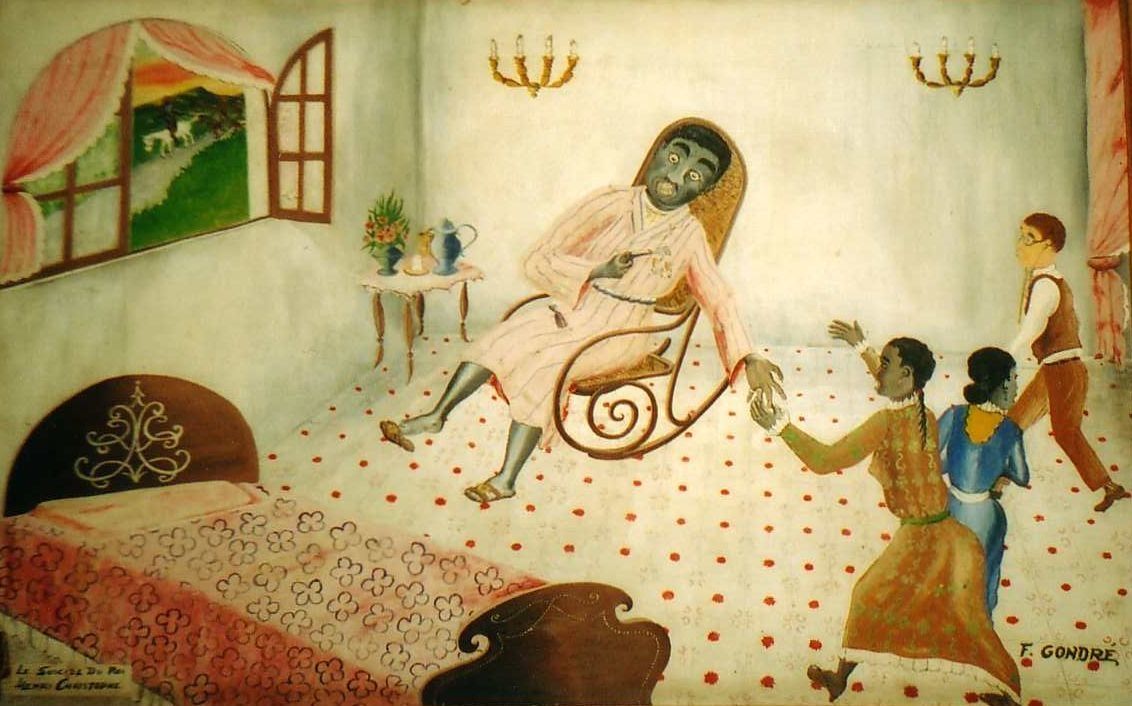
François Gondre, ‘Le Suicide du roi Henry Christophe’ (date unknown)
As Haiti and Scotland prepare to meet in the men’s football World Cup on Saturday (or early Sunday morning on this side of the Atlantic), it might be a good time to remember another time representatives of thetwo countries came together on a historic occasion.
The painting here is by the Haitian artist François Gondre and entitled ‘Le Suicide du roi Henry Christophe’.[1]In 1820, King Henry, already weakened by a stroke, and sensing that the end of his reign was nigh, as his own soldiers were defecting to the rebel army, took his own life, allegedly shooting himself with a silver bullet.What is interesting about Gondre’s version is that he includes in the scene his Scottish physician, Duncan Stewart, who was appointed professor of anatomy and surgery earlier that year, clearly identifiable with his pale complexion and distinctly red hair.
A more recent encounter was when the Haitian writer and artist Franketienne visited Scotland in 2014, organised by Rachel Douglas of Glasgow University, author of a fine study of his work, Franketienne and Rewriting (2009). A highlight for me was his readings from Rapjazz (2011) accompanied by Mark Mulholland.
When I visited Haiti for the celebrations of the bicentenary of independence on 1 January 2004, I remember telling my hosts that the tune that a band was playing in a bar down the street was ‘Auld Lang Syne’, and where I lived everyone would be singing it at midnight. I made a stab at Burns’ lyric. They had no idea.
The next day I was chatting to a young woman visiting the family. She was studying in the Dominican Republic. I asked her what it was like there, grabbing my notebook and pen. ‘Wout yo se pi bon,’ she said simply. The roads are better.
Or, as Sorley Maclean put it, ‘Tha na rathaidean nas fhearr’, responding to news of the completion of the Preston By-Pass in 1958. Just kidding. But in his epic poem An Cuilithionn (1939) he did namecheck Toussaint Louverture in a list of revolutionary heroes in Part VII:
Air na sgurrachan mun cairt,
bha na beò-mhairbh a thug buaidh:
Toussaint, Marx, More, Lenin,
Liebknecht, Connollaigh, MacGill-Eain
agus iomadh spiorad àrdain
a chuireadh às an càs na Spàinne.
On the peaks around
were the living dead and their triumph:
Toussaint, More, Lenin, Marx,
Liebknecht, Connolly, Maclean,
and many a proud spirit
extinguished in the extremity of Spain.[2]
[1] Photographed by me on a visit to the Musée d’art haitien in Port-au-Prince in January 2004.The gallery was badly damaged in the 2010 earthquake and I have not been able to ascertain whether this painting survived.
[2] Somhairle MacGill-Eain / Sorley MacLean, An Cuilithionn 1939 and Unpublished Poems, ed. Christopher Whyte. Glasgow: Association for Scottish Literary Studies, 2011, 103.
Marking each day of the holidays with twelve quotations that each feature a chiasmus.
‘A certain redressing of the cosmic balance seems to have occurred: this time not only have I written about them, but they have written about me too.’ (Cees Nooteboom, Nomad’s Hotel)
‘I want you to say you love me, even though I don’t love you. It might restore the balance.’ (Claire Keegan, ‘Quare Name for a Boy’)
‘My honour is not what I proclaim to you about myself but what you proclaim to me.’ (Bertholt Brecht, Me-Ti: Book of Interventions in the Flow of Things, trans Antony Tatlow)
‘Yes, we have rendered to these true cannibals war for war, crime for crime, outrage for outrage; yes, I have saved my country; I have avenged America.’ (Jean-Jacques Dessalines, proclamation of 28 April 1804)
‘I wonder if they recognise me as quickly as I, them’. (Dionne Brand, ‘At the Lisbon Plate’)
‘Men look. So do women. Women look too. So ha ha there. If men dont think they do, they do, women look at men.’ (James Kelman, Mo Said She Was Quirky)
‘A wedding gift of dishes. “It starts when you sink in his arms…”’ (Kathleen Jamie, Surfacing)
‘Aye, he’s chasing me now, not I, him.’ (Herman Melville, Moby-Dick)
‘Most tasks are easier said than done. In the case of coming together across seemingly intractable barriers, however, the reverse may be true: this one is easier done than said.’ (Naomi Klein, Doppelganger)
‘What is the blue road anyway but an opportunity to poke at the unseen and a hoping the unseen will poke back?’ (William Least Heat-Moon, Blue Highways)
‘The yes becoming no, the no becoming yes, the yes becoming both yes and no, the no becoming both no and yes, the contraries balance, neutralise, paralyse each other.’ (Karl Marx, The Poverty of Philosophy)
‘It is ever so hard for people to wrap their minds around the idea that someone could have been the enemy of your enemy and yet not a benevolent force. A victim and also a perpetrator. Or vice versa.’ (Masha Gessen, ‘In the Shadow of the Holocaust’)
The American radical campaigner, Henry Clarke Wright spent much of 1844-45 touring Scotland, making incendiary speeches condemning the Free Church for accepting donations from pro-slavery supporters in the United States. In one of his regular updates to William Lloyd Garrison, the editor of the Liberator, the abolitionist paper in Boston, he wrote from Arbroath on 11 February 1846:
When I was in this town in October of 1845, Rev. Mr. Sorley, in whose church I lectured, was away, getting a wife. Whom do you think he married? A COLORED WOMAN, the daughter of a slave, quite dark, but highly educated and accomplished, and of exalted character. She is the cherished object of respect and affection among all the people of this town. No woman in town is more beloved and respected. What will the negro-hating priests and politicians of America say to this? Here is a white husband and a black wife, and that husband a minister – greatly honoured by his people, and his black wife adds to his respectability.[1]
The occasion of Wright’s return to Arbroath was to arrange speaking engagements for himself and Frederick Douglass, then busy delighting audiences in Dundee. Wright had hoped to book Sorley’s church again, but from the reports in the Arbroath Guide and Northern Warder, it appears that he failed to find a church willing to accommodate them, and they had to settle instead for the smaller Trades’ Hall on the High Street for their first meeting on 10 February. They were then offered the Abbey Church (which stood across from Sorley’s and is still there today) and the following two evenings they spoke there.
Former Trades Hall, Arbroath.
Abbey Church, Arbroath
Sorley’s wife, whom Wright does not name, was Eliza Greenfield. She was born in Kingston, Jamaica and according to the baptismal records [free registration required] she was the daughter of a ‘free mulatto’, Elizabeth Strachan. Her father was James Greenfield, not otherwise identified there, but he does have an entry in the Legacies of British Slavery database, indicating that he was a partner in a firm that made him ‘joint-owner of … enslaved people contracted to the military and government in Jamaica.’ He had an interest in several estates, and was ‘shown as an absentee in 1826.’ Greenfield’s descendants believe that the unnamed admiral’s agent in Tom Cringle’s Log – Michael Scott’s fictionalisation of his experiences in the Caribbean, first serialised in Blackwood’s Magazine in 1829 – was their ancestor. He is described as a ‘remarkably neat personage’ who enjoyed entertaining at his mansion, assisted by a ‘very well-dressed brown woman’ speaking patois who can only be his long-standing mistress and mother of several of his children.
That ‘Legacies’ entry does not mention Eliza (born 1812), but it does record that Greenfield had several other children by Elizabeth Strachan (whose surname suggests that her father was a Scottish colonist too). There was Agnes (born 1814), James (born 1818), Mary (born 1820) and Barbara (born 1825). There were two other daughters: Margaret, ‘a free mulatto child’ whose mother is not identified (born in 1817) and Jane Anna, whose mother was Thomasina Freeman, a ‘free quadroon’ (born around 1809), Greenfield returned to his home town Edinburgh some time in the 1820s, with several of his Jamaican children.
He lived at 9 East Claremont Street, a house he shared, according to the 1841 census, with his daughter Agnes, his niece Margaret Home Montgomery and her son Hume, whose father may have been Greenfield (he refers to him as his son in his will and Hume’s register of marriage identifies them both as parents). Agnes’ sister Margaret, had already left home and married Hector Gavin, a physician, in Edinburgh on 12 Dec 1837 [Register of Marriages, St Cuthbert’s]. In 1841 they were living in Bethnal Green with another sister, Mary [1841 Census] who two years later would marry William Sage, a chemist [Register of Marriages, Stepney]. Meanwhile Agnes had also moved to London, marrying William Goodchap, an accountant, in 1842.[2]. Eliza had also moved on, joining her cousin Elizabeth who had relocated to Arbroath after marrying a schoolteacher there in 1837, possibly to help look after their second child, James Hume, born in 1840. Eliza is listed in the 1841 census as residing with them at Millhead, a woman of independent means, marked with an ‘F’ for ‘foreign-born’.
Here already we have the beginnings of the story of one family of what Daniel Livesay called, ‘Children of Uncertain Fortune’, the title he gave to his study of the migration of ‘mixed-race’ Jamaicans to and from Britain in the ‘long eighteenth century’.[3] Like many of these children, three of the sisters ended up in London – their brother James too it seems – but Eliza remained in Scotland.[4]
II
How many black people were living in Scotland at this time? It is very hard to say. Most attempts at a headcount focus on the decades around 1800 and draw on data for London and extrapolate out for ‘the whole country’ (which may or may not include Scotland). The two most reliable studies estimate around 10,000, which suggests that, even on the most generous apportionment, the number north of the border is unlikely to be more than two thousand.[5]
Certainly, we know the names of only a very small number of them. Livesay does not mention the Greenfields, but he does discuss the Jamaican offspring of John Tailyour (surnamed Taylor), whose passage he arranged to Montrose, where he purchased a grand house at Kirktonhill in 1792. The boys were sent to boarding school in Yorkshire, but Catherine seems to have stayed in the area and lived with her aunt.[6] The Tailyour family probably helped to arrange the education of Edward Stirling, the son of a planter in Jamaica and a ‘creole woman of colour’: he and his cousin were pupils at a small parish school in St Vigeans in Angus. Stirling subsequently worked at the firm of J and A Dennistoun in Glasgow and later emigrated to Australia in 1839 where he set up a business that became involved in copper mining.[7]
Livesay also mentions a John McIntyre, who was a pupil at Dollar Academy in the 1820s and went on to practice medicine in Doune.[8] From Jamaica too were Peg Williamson, who worked as a midwife for most of her life in Banffshire, and Nancy Graham, who settled in Cromarty, and acquired substantial wealth including a plantation in Surinam.[9]
The three children of William Macpherson, an overseer in Berbice, returned with him to Scotland in the 1810s, Eliza and Matilda attending school in Blairgowrie, while William was enrolled in a boarding school near Perth.[10] Also from Berbice was John Fraser, apprenticed to a surgeon in Cromarty in 1832.[11] David Alston has identified several individuals born in the Caribbean in the rolls of educational institutions: Marischal College, Aberdeen (George, John and William Munro), Inverness Academy (John Noble, Helen Inglis), Elgin Academy (James Botar), Tain Academy (Marion Iver, Eve and George Oudkerk), and Fortrose Academy (Eliza and William Junor) while Thomas Cuming graduated as a doctor from Edinburgh University in 1824.[12] Another doctor trained at Edinburgh University was Harry, a son of Dolly Thomas, a former slave turned wealthy slaveholder herself in Demerara; several of her grandchildren were educated in Scotland too.[13]William Fergusson and Jean-Baptiste Philip(pe) also graduated there in the 1810s before going on to careers elsewhere.[14]
William Davidson may have picked up some schooling in Edinburgh and Aberdeen in a checkered trajectory that ended with his execution in London in 1820 for his part in the Cato Street Conspiracy.[15] Ian Duffield has identified several black Scots from Edinburgh and Leith who were transported to New South Wales in the 1820s and 30s, including Nameroa (aka Nimrod, ‘Black. Robbin’, Robertson) in the service of a Major-General Dalrymple, Christian Sanderson, a laundry maid, and William Green, a private in the 70th Regiment of foot.[16]
Several are better known. Malvina Wells, born enslaved in Carriacou in 1804, lived and worked as a maid in Edinburgh for much of her life. John Edmonstone, from Guyana, taught taxidermy at Edinburgh University in the 1820s, where one of his students was the young Charles Darwin.[17] And Peter Burnet, an African American who made his home in Paisley was a well kent figure about town town and the subject of a short biography.[18]
It is striking how so few thumbnail sketches can suggest quite a wide range of opportunities were open to such children. Some certainly faced financial hardship and struggled to find employment that might have lifted them out of poverty, but family connections meant that some benefited from a good education, and even inherited substantial wealth; a few owned plantations and their enslaved workers. The sample, however, is unlikely to be representative, given the factors that govern the creation of an archival footprint. Only a small number seem to have been politically active.
III
Eliza Greenfield is worthy of a place among this select company. What do we know of her life in Arbroath? The records tell us that she married the Rev. Alexander Sorley on 21 October 1845. He was then the minister of the United Secession Church on Fore (now West) Abbey Street, now no longer standing. The ceremony itself took place in Edinburgh, her residence, according to the register, the same as her father who is described as ‘late merchant of Jamaica.’ As for the later references in the archives, she has but a shadowy presence.Sorley was a popular preacher, known especially for his sermon to the sailors, delivered every Spring before the sailing of the Baltic fleet.[19] One of his pet projects was launched in October 1847 when he proposed ‘the formation of an Association for the promotion and improvement of sacred music in Arbroath.’[20]
Following the merger of the United Secession and Relief Churches to create the United Presbyterian Church in 1847, Sorley took his congregation to a new building in 1851, known as the Erskine Church in Horner’s Wynd (now Commerce Street) with some 800 sittings.[21] In 1863 his stipend was increased by £30 to £200 a year, with an additional allowance of £30 for a manse.[22]
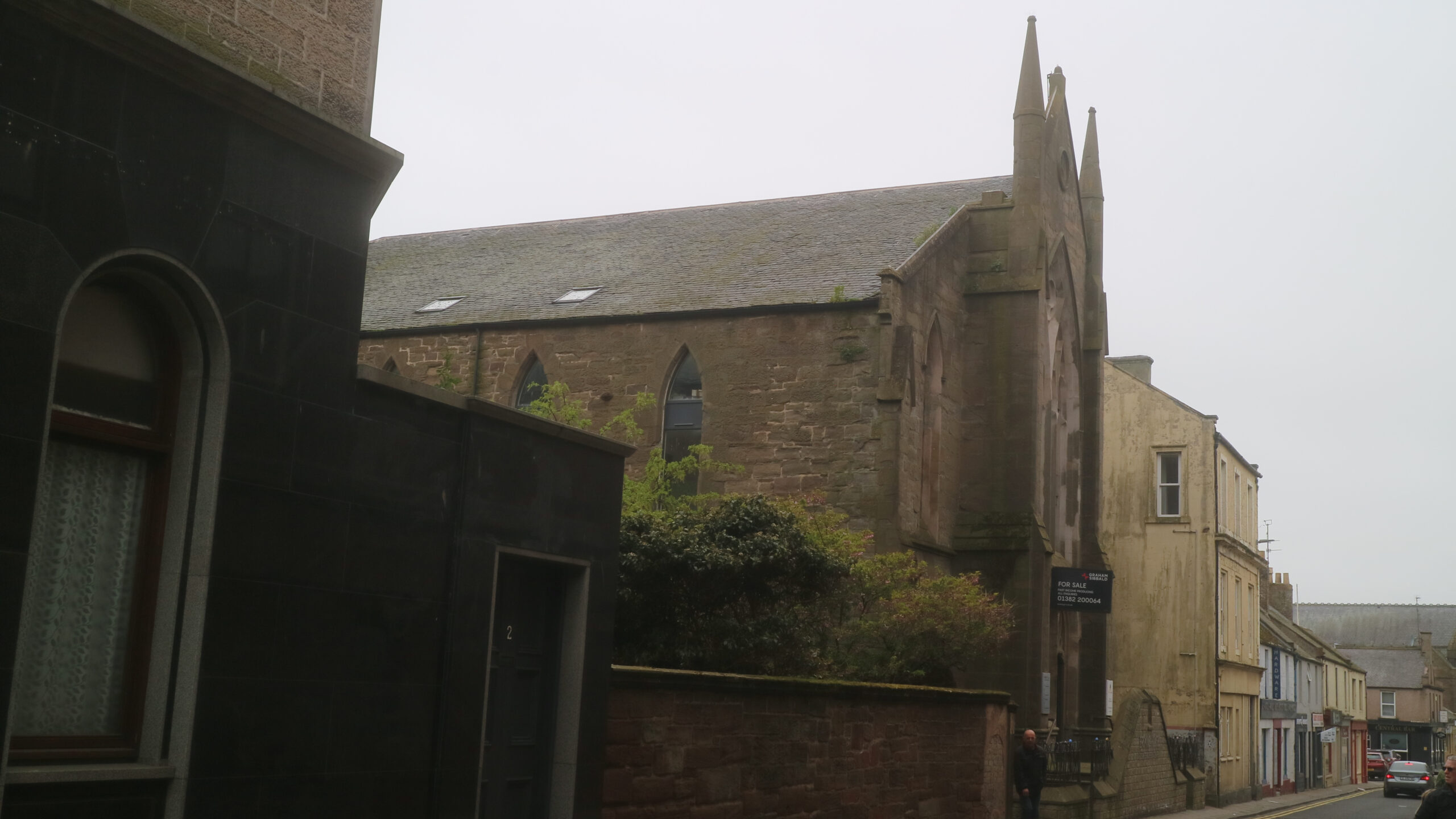
Former Erskine Church, Arbroath
We know Eliza was a talented pianist – she may have been taught, as her sister Margaret was, by John Robertson at his music school in Edinburgh.[23] She accompanied pupils at exhibitions of sacred music at Arbroath Academy, and performed solos and duets at social events at her husband’s church, which she was was responsible for organising.[24] Eliza served on various fund-raising committees and kept stalls at bazaars, supporting causes such as the Charity School, Arbroath Ladies’ Clothing Society, the First Forfarshire Artillery Volunteers and casualties in the Franco-Prussian War (articles to be divided equally between the two sides).[25]
A newspaper report of a ‘fancy bazaar in connection with the Carnoustie United Presbyterian Church’, held at the Kinnaird Hall, Dundee in October 1873, gives a good idea of such occasions:
A peep at the Kinnaird Hall last night would have been sufficient to convince the most sceptical, that the ladies of Mr Millar’s congregation and their numerous fair friends mean to do business, and are prepared to do it very extensively too. On the east and west sides of the hall six stalls have been fitted up, in a beautiful style becoming the occasion, and these are now laden with fancy wares of the most glorious colours and most exquisite workmanship, while more sober, if also more directly useful articles, have their place, although as becomes their character they do not obtrude themselves too forcibly on one’s attention. Perhaps, before long, they may have some assistance from those in charge of them in doing this. The stalls all vie with each other in point of fullness. Apparently every inch of space where an article will lie or hang is occupied, and it is a mystery only known to the initiated how the ladies can move about being among such a quantity of goods as was displayed round about them last night when we were admitted to a private inspection of the bazaar. The hall itself has been lavishly decorated with flags and banners, and a fine collection of greenhouse plants from Panmure and Carnoustie are arranged in the hall in front of the platform. Beautiful bouquets of flowers placed here and there among the plants produce a fine effect; and altogether the hall has a most charming appearance, which is considerably enhanced by the presence in strong force of the fair superintendents of the stalls, all full of animation and confident expectation of ‘roaring’ trade.
The author goes on to describe each of the six stalls in detail, including
STALL No. 2. – This stall is presided over by Mrs Sorley and Mrs Robert Lumgair (Arbroath), Mrs Thomson (Arbirlot), Mrs Marwick, and Mrs Anderson, assisted by Miss Weir, the Misses Ritchie, and Miss Nelly Ireland. Here again the bright-coloured sofa blankets compel some notice, as do also the quantity of coseys. Prominent on this stall is a small ottoman of the most magnificent workmanship, an exceedingly handsome fender stool, and skeleton flowers in a glass shade. There is also a Singer sewing machine here, which will be raffled for.[26]
Eliza never knew the back-breaking toil of the plantation, but she would have been aware of her inferior status from a young age, in what was the leading slavery port in the British Atlantic, a highly stratified society where newly landed African captives were turned into chattel. And she and her siblings could not have escaped the patronising or censorious gaze of respectable Edinburgh, hardly satisfied with their father’s claim that they were his ‘Spanish nieces’. Yet she came to be accepted into a community on the North Sea coast that took for granted its prosperity far from the frontiers of Empire whence much of it came. Did she ponder any of this when she and her husband were special guests at a Banquet and Freedom of the Burgh of Arbroath to Major Rait of the Ashantee Expedition the following year.[27]
Eliza’s father died in 1857. Greenfield [Edinburgh Sheriff Court Wills] left everything to his son Hume, excepting an annuity of £150 to his niece Margaret. Had Hume predeceased his father, the estate would have been divided equally between Margaret and four of the five Jamaican children then living in Britain: Eliza, Agnes, Mary and James. (Why their sister Margaret Gavin was excluded is not known).
In the 1861 Census the Sorleys are recorded as living in a large detached house, Belmont, on Millgate Loan. The Valuation Rolls for 1865 are interesting for its indication of the occupations of their neighbours: manufacturer, surgeon, solicitor, flesher, grocer, then – on the less prosperous Millgate – china merchant, draper, printer, flesher, jeweller, mill foreman, weaver, millworker, mechanic, labourer – mainly terraced houses on way into town centre.
House formerly known as Belmont, Millgate Loan, Arbroath
In 1875, Alexander Sorley resigned as minister of the Erskine Church due to failing health, and less than two years later, died aged 68. On the day of his funeral, a large body of mourners walked from the Abbey burying-ground to the home of the deceased, all the shops along the route closed as a mark of respect.[28]
Eliza would live another eight years. In the 1881 Census Eliza is listed as widow, head of household, aged 64, born Jamaica, living with two servants, Jemima Grant and Anne Esplin. The Register of Eliza’s death (7 March, 1885) has her address as ‘Belmont, Millgate Loan, Arbroath’ and she is described as the ‘Widow of Alexander Sorley, Minister of Erskine U.P. Church. (Illegitimate),’ her father as ‘James Greenfield, Merchant, Kingston Jamaica (deceased),’ and her mother as ‘not known.’ Her personal estate was valued (after debts) at £5673 16s 11d. She is buried with her husband and his first wife in the grounds of Arbroath Abbey.
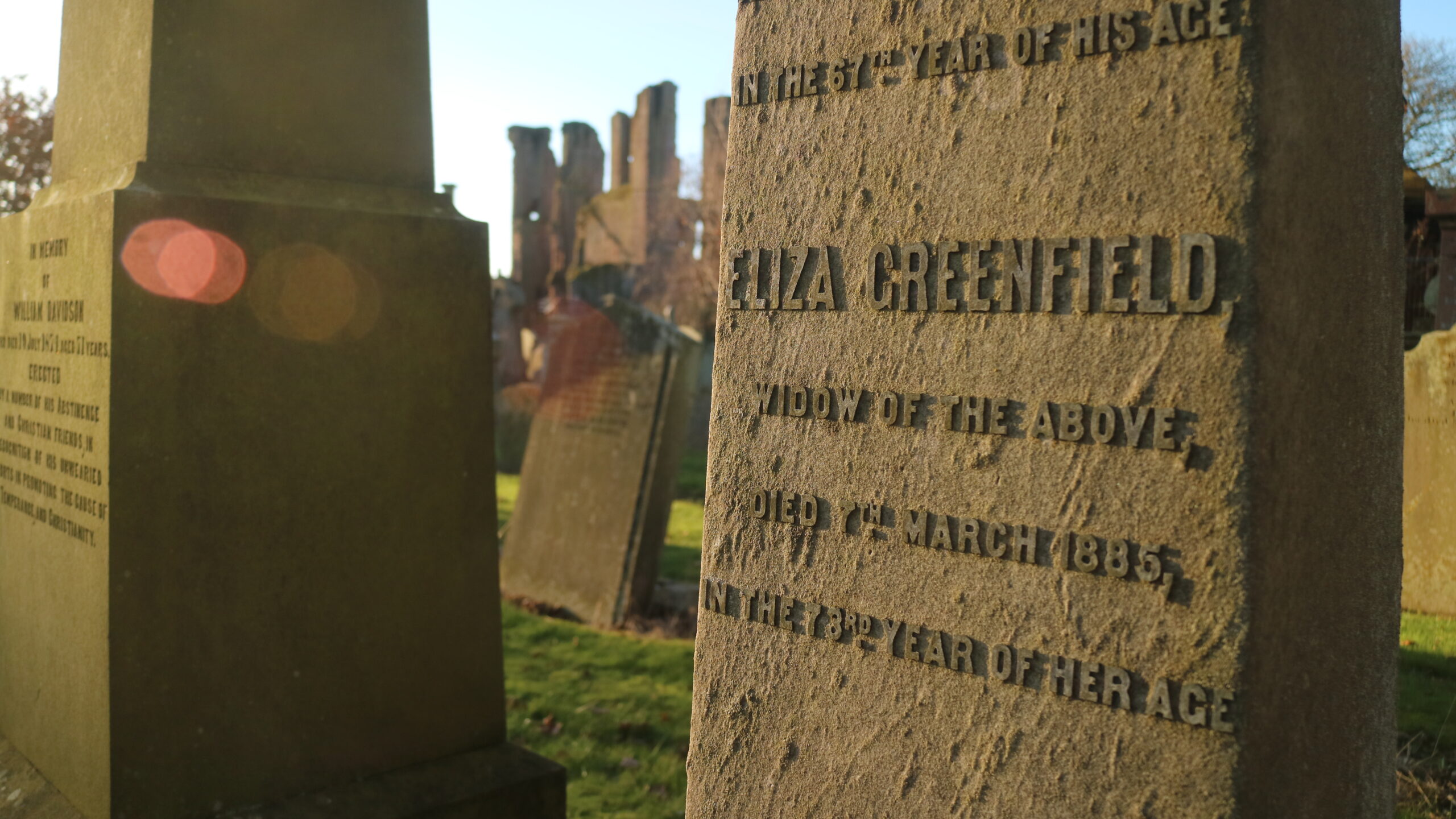
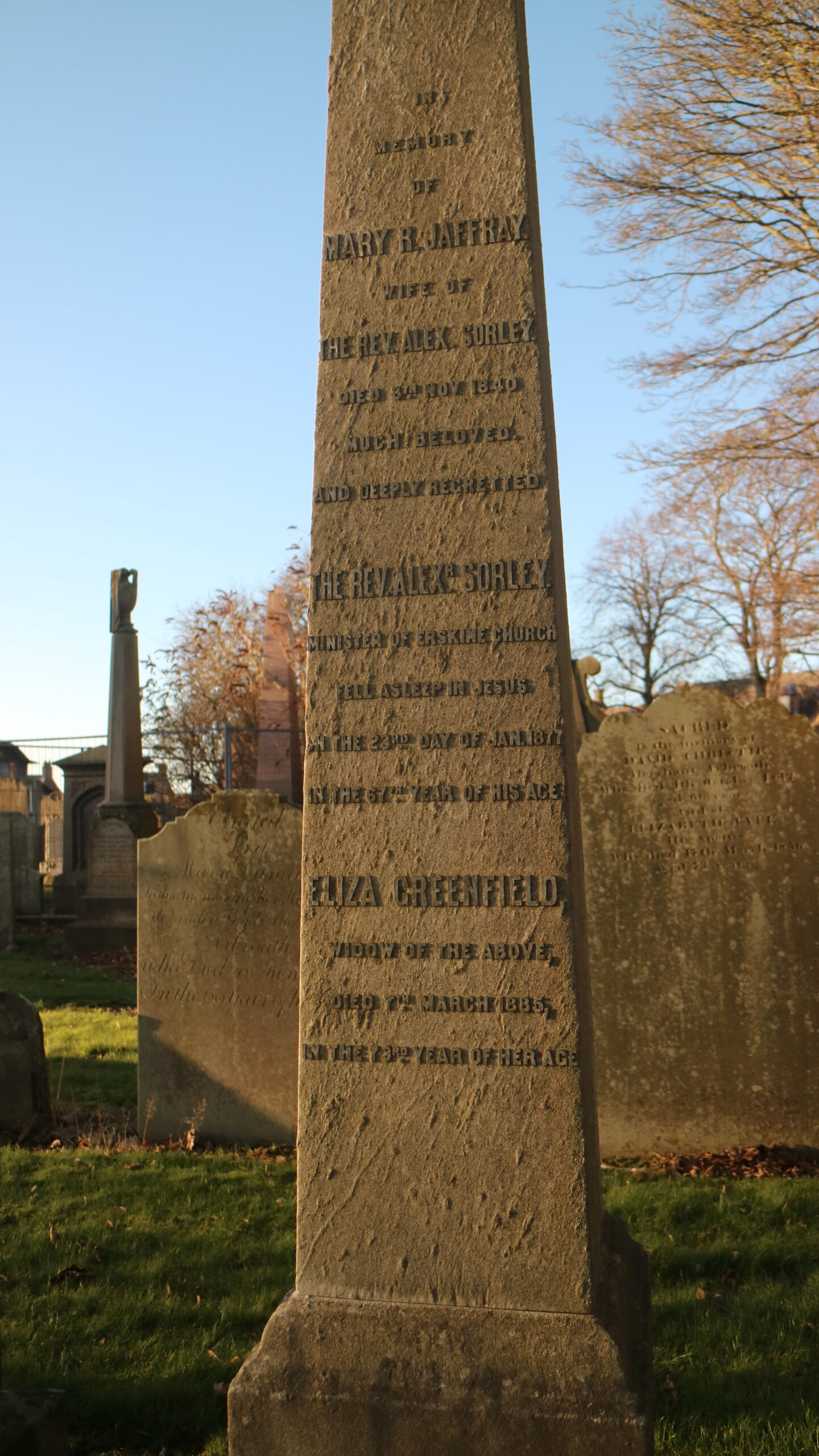
Grave of Eliza Greenfield, Alexander Sorley and Mary Jaffray, Arbroath Abbey.
In her will [Forfar Sheriff Court], made a year before, we might glimpse something of her life in Arbroath and who meant most to her. Here is the important passage, with the beneficiaries highlighted.
I Eliza Greenfield Sorley, relict of the late Revd Alexander Sorley of Erskine UP Church Arbroath do hereby make my Will on this Twenty first day of February 1884 bequeathing to my step daughter Mrs Jane Ann Sorley Bartlett whom failing her to her children my House Belmont, Arbroath with Furniture Silver Linens and all contained in the house excepting all the China and Ornaments in the Drawing room to my dear friend Mrs Marion Logan or McClure residing in Greenock. My step daughter to be my sole Executrix. All the money I possess in whatever way laid out to my said step daughter and failing her to her children. My step daughter shall pay out of my Estate to the following: To my sister Mrs Agnes Greenfield or Goodchap Roseneath Lodge, Lee, Kent One thousand. To my cousin James Hume Webster Four hundred pounds. To my friend Mrs Agnes Lyon or Charles Corsar, Seaforth, Mrs William Corsar’s Brooch with one of my gold Bracelets. To Mr Charles Corsar Twenty five pounds. To Mr William McClure, Senr Writer in Greenock Fifty pounds. To Jemima Grant my faithful Servant the sum of One hundred pounds all my clothes xlaid my Gold Watch and gold chain if she is in my service at my death. To Mrs Agnes Webster or Harvey my Gold Bracelet with my father’s miniature in it. I leave no debts. Medical Funeral and servants mourning to be paid as soon as possible.
Let us consider them one by one and speculate how Eliza might have known them. There is much guesswork here, but it might inspire further research. There is already the framework for a historical novel, perhaps.
Mrs Jane Ann Sorley Bartlett. Eliza’s stepdaughter, from her husband’s previous marriage to Mary Jaffrey, who died in November 1840, only three weeks after her daughter was born [gravestone; no statutory record of death]. The 1851 Census shows her living with her father and stepmother and it is evident that she was a pupil at Arbroath Academy.[29] By the time she was 20 she was living with Ebenezer and Jessie Thomson in the village of Friockheim, a few miles north west of the town [1861 Census]. As the will indicates, she subsequently married, in 1872, Joseph Bartlett,[30] a doctor of medicine in London, deceased at the time of the will, having died in 1882 [Register of Deaths, Kensington]. She gets the house, but remained in Notting Hill, selling it soon afterwards for £900 to Mr James Cargill on behalf of a client.[31]
Mrs Marion [Stewart] Logan or McClure. A ‘dear friend’. Marion Logan was born in Stirling on 25 November 1822 to Rev James Logan and Catherine Stewart [Parish Register of Births, St Ninians], her father having been minister of St Ninians’s Relief Church since 1803.[32] She moved to Pitt Street in Leith with her parents around 1839 [PO Directories] and so was living a short walk away from Eliza for a year or two and they may well have met each other then. They were ten years apart in age (28 and 18 in 1840) but perhaps Eliza was her tutor? If they did meet then, it is possible that Marion’s father (at whose church Mary Jaffrey and Alexander Sorley were married – in 1837) (Parish Register of Marriage, St Ninian’s] could have introduced Eliza to her future husband. In any case, Marion is likely to have attended Eliza’s wedding in Edinburgh in 1845. After Marion married in 1851 [Parish Register, St Cuthbert’s, Edinburgh] she went to live with her husband in Greenock (see eg 1871 Census). To be a ‘dear friend’ in the 1880s must mean they kept in touch over many years, but, separated by over a hundred miles, probably didn’t see each other often. Marion gets China and Ornaments in the drawing room. Her husband William McClure – identified as a solicitor here – is a separately named beneficiary, with £50 to him.
Mrs Agnes Greenfield or Goodchap. ‘My sister’. She is the only sibling mentioned in the will. We do know that of the four siblings who settled in Britain, James died in 1866 [citation missing], Margaret in 1876 [citation missing], and possibly Mary too by the time of the will. Agnes gets the largest cash portion: £1000.
James Hume Webster. ‘My cousin’. Actually cousin once removed, in other words, the son of her father’s other niece, Elizabeth Steel(e) Montgomery (1810-1889) (Parish Register of Births, Edinburgh; Statutory Register of Deaths, Arbroath) who moved from Edinburgh to Arbroath after marrying an English teacher at Arbroath Academy, Alexander Webster in 1837 [Parish Register of Marriages, St Cuthbert’s]. James Hume was born 1840 [Parish Register of Births, Arbroath]. And Eliza was living with the three of them (actually also another Alexander Webster, grandfather perhaps, so four) at Millhead according to the 1841 Census. Eliza may well have formed a close attachment to him as a baby and they remained close. The family moved to Academy Street where, according to the 1851 Census they had four more children. By 1861 James was working as a solicitor’s clerk in Edinburgh and was still there two decades later (1861 and 1881 Censuses). He died in 1906 aged 65, mother’s maiden name Montgomery) (Statutory Register of Deaths, St Giles). James gets £400, an indication perhaps that Eliza remained in touch with him after he went away to pursue a legal career.
Agnes [Johnstone] Lyon or Charles Corsar. ‘My friend.’ Agnes was born in Arbroath in 1835 [Arbroath Parish Register of Births]. According to the 1841 Census she was living with her parents and three siblings at Seaforth House, on the south edge of town. She married Charles Webster Corsar (1836-1900) in 1860 [Statutory Register of Marriages]. The 1871 Census indicates that they lived at Seaforth House, just a few minutes’ walk from the Sorleys, with four children (David, William , Marjory, Jane). Corsar & Sons were a successful business in Arbroath. In 1849 Corsar and Sons launched mass production of their top quality Reliance sailcloth. Importing flax from the Baltic. The oldest son William H Corsar died 1886, and ‘the youngest and sole surviving partner, Charles Webster, inherited an estate “valued at some hundreds of thousands, I know not how many” according to his brother in law, a local preacher retained by the Corsars on a stipend of £50 per annum. Three sisters were to receive £10,000 each and two nephews £4000’. Charles Webster went on to build sailing ships, naming one ‘Monkbarns’ after the character in Scott’s Antiquary. ‘By the time Charles Webster died, in 1900, he left a fortune valued by the Arbroath Herald at about a quarter of a million pounds, in flax, yarn, cloth, stores, machinery, mills, factories – and ships. Nine ships in all.’[33]In her early twenties, Agnes, like Eliza, was on the committee of the Arbroath Ladies Clothing Society, and after her marriage was often mentioned with Eliza in newspaper reports of church fundraisers, Charity School annual examinations, helping the war wounded. Her husband was Secretary of the Erskine Church committee. The families were evidently close. Agnes gets ‘Mrs William Corsar’s brooch’ – returning a gift (or legacy) from one of Agnes’ sister- or daughter-in-laws. And Charleshimself gets £25, not that he needed it, but a symbolic token of affection.
Jemima Grant. ‘My faithful servant’. She gets £100, clothes and accessories.
Mrs Agnes Webster or Harvey. Not identified as such, but the sister of James Hume Webster, another cousin (once removed). Agnes was born 21 Oct 1847 [Parish Register, St Vigeans, Arbroath], and I think she is the same person as ‘Janet A’ (aged 3) who appears in the 1851 Censusfor Academy Street. She does not appear in the 1861 Census when the family had moved to Commerce Street (though this does indicate that her father Alexander is now a ‘retired teacher of English’), but does in the 1871 Census (barely legible, but has her father Alexander, aged 66, with occupation now as ‘registrar or births’, and a daughter, aged 23). In David Dobson’s Scots in the USA and Canada 1825-1875 we learn that ‘Webster, Janet Agnes, daughter of Alexander Webster, the registrar of Arbroath, married William A. Harvey, engineer, Royal Navy, in Halifax, Nova Scotia, on 19 April 1880.’[34] In the 1891 Census she is listed as head of household, age 43, 19 Dalhousie Place, ‘wife of [head engineer?] with son 10 and daughter 8 and servant. So Agnes is sometimes called ‘Janet A’ and sometimes ‘Janet Agnes’. This is possibly because the first-born child was called Janet (and she is the infant living with her grand-uncle James Greenfield in Edinburgh in 1841); she died young, and her name was transferred to her younger sister.[35]Agnes gets ‘my Gold Bracelet with my father’s miniature in it’. Her father, note, is Agnes’ grand-uncle.
IV
One other person of interest is Alexander Webster. According to the record of his daughter’s marriage in 1880 he was the Registrar of Births, Marriages and Deaths in Arbroath.[36] But at the time of his own marriage in 1837 he was an English teacher at Arbroath Academy (Parish Register of Marriages, St Cuthbert’s). Ten years later he was recorded as a member of the committee of the association established by Sorley for the promotion and improvement of sacred music in Arbroath.[37] According to McBain’s Arbroath: Past and Present, Webster ‘threw in [his] lot with the Free Church’ when it broke away from the Church of Scotland in the Disruption of 1843 and only a storm of protest prevented the Directors from sacking him.[38] So before she was married, Eliza was living in the home of a prominent supporter of the Free Church. What would have been her reaction to her fiancé apparently welcoming Henry Clarke Wright deliver a ‘Send Back the Money’ lecture at his church a few weeks before their marriage in October 1845? Perhaps her disapproval was the reason he back-tracked and did not allow Douglass to speak there the following February. But perhaps Webster was one of those in the Free Church who disapproved of its willingness to extend fellowship to its counterparts in the United States. After all, one of the two ‘overtures’ presented to the General Assembly in 1846 calling on the Church leaders to reconsider their position on slavery, came from the Angus and Mearns Synod to which the Arbroath Presbytery belonged. Did the presence in his household of a daughter or granddaughter of an enslaved mother trigger a family crisis in this small coastal town that reverberated – however faintly – in an abolitionist newspaper in Massachusetts?
[Work in progress. Last updated 3 February 2025]
[1] Henry Clarke Wright to William Lloyd Garrison, Arbroath, 11 February 1846, Liberator 3 April, 1846.
[2]Caledonian Mercury, 22 September 1842. See also Register of Marriages, Shoreditch.
[3] Daniel Livesay, Children of Uncertain Fortune: Mixed-Race Jamaicans in Britain and the Atlantic Family, 1733–1833 (Chapel Hill: University of North Carolina Press, 2018).
[4] Information about James is hard to come by. But we do know that in 1849 he appeared in court after he assaulted his brother in law, William Sage (his sister Mary’s husband): Morning Herald, 15 October 1849.
[5] Norma Myers, Reconstructing the Black Past: Blacks in Britain, 1780–1830 (London: Frank Cass, 1996), p.29; Kathleen Chater, Untold Histories: Black People in England and Wales During the Period of the British Slave Trade, c.1660–1807 (Manchester: Manchester University Press, 2009), p.30. Their figure matches that of Folarin Shyllon, though, as Chater points out, he did not indicate how he arrived at the figure: F. O. Shyllon, Black People in Britain, 1555–1833 (London: Oxford University Press, 1977), p.102.
[6] Livesay, Children of Uncertain Fortune, pp. 186–88, 227–31, 281–91, 323.
[7] William Ferguson Clark, ‘John Bowman, Schoolmaster of St Vigeans and his Pupil, Edward Stirling: The Story and the Sources’ (2022).
[8] Livesay, Children of Uncertain Fortune, p. 357; June Evans, ‘African / Caribbeans in Scotland: A Socio-Geographical Study’, PhD Dissertation, University of Edinburgh, 1995, p. 77. Bruce Baillie, History of Dollar (Dollar: Dollar Museum Trust, 1998) calls him Daniel McIntyre (p 75).
[9] David Alston, Slaves and Highlanders: Silenced Histories of Scotland and the Caribbean (Edinburgh: Edinburgh University Press, 2021), pp. 4–5, 287–89.
[10] Stephen Foster, A Private Empire (Millers Point, NSW: Piers 9, 2011), pp. 163–93. Their father’s mother did not consider them worthy of the family name, and so were called Williams, after their father’s forename (pp. 175, 177). See also Livesay, Children of Uncertain Fortune, pp. 355–61.
[13] Kit Candlin, The Last Caribbean Frontier, 1795-1815 (Basingstoke: Palgrave Macmillan, 2012), 45-48.
[14] Lisa Williams, ‘African and Caribbean Residents of Edinburgh in the Eighteenth and Nineteenth Centuries’, Kalfou, Vol 7 No 1 (2020), 46; Lorna McDaniel, ‘The Philips: A “Free Mulatto” Family of Grenada’, Journal of Caribbean History, Vol 24 No 2 (1990).
[16] Ian Duffield, ‘Identity, Community and the Lived Experience of Black Scots from the Late Eighteenth to the Mid-Nineteenth Centuries’, Immigrants and Minorities, Vol 11 No 2 (1992), 105-129.
[17] Mark Duffill and Eric J Graham, ‘John Edmonstone – the Black “Bird-Stuffer” of Edinburgh’, History Scotland (January/February 2007), pp. 20–22.
[22]Montrose, Arbroath and Brechin Review, 13 November 1863.
[23]Scotsman, 14 June 1834; Caledonian Mercury, 13 July 1833. The Academy seems to have been located between Princes Street and Queen Street.
[24]Montrose Standard, 23 July 1852; Montrose Standard, 4 October 1861; Arbroath Guide, 5 October 1861; Arbroath Guide, 29 January 1870; Dundee Courier, 5 February 1870;
[25]Dundee Courier, 29 Jue 1871; Arbroath Guide, 29 June, 1872; Dundee, Perth and Cupar Advertiser, 14 December 1855; Dundee, Perth and Cupar Advertiser, 10 June 1856; Montrose Standard, 6 June 1856; Montrose Standard, 3 June 1859; Dundee, Perth and Cupar Advertiser, 7 June 1861; Montrose Standard, 30 September 1870.
[34] David Dobson, Scots in the USA and Canada, 1825–1875, Part Five (Baltimore: Clearfield, 2007), 146.
[35] Notices announcing the death of a J. Agnes, daughter of Mr Webster of Arbroath Academy, aged eight and a half years on 21 September 1846 confirms this: Montrose Review, 25 September 1846; Aberdeen Press & Journal, 30 September 1846.
[36] See also 1871 Census; Oliver & Boyd’s New Edinburgh Almanac 1874.
[37]Dundee, Perth and Cupar Advertiser, 19 Oct 1847
I know Mike did a convincing impression of being a South Londoner. He made a pretty good stab at it. Others will testify to his life as a singer in the Jivin Instructors, devoted follower of Crystal Palace FC, and proud public servant with Southwark Library services.
But for me he was always from the North. Someone who may have parked his accent, but never lost it. Someone who never stopped loving the open spaces of the Pennine moors that backed on to the towns we grew up in, places you could escape to, and slip the parental knot.
I first met him one December morning when he padded into the kitchen at the hotel I worked in, starting a three-week holiday job. Shoulder-length hair and a droopy moustache. He used to say he saw my books before he saw me, after noticing a copy of Finnegans Wake on the window sill of the chalet I bunked in. The spines of my library ostentatiously facing out. It was a bare-faced lie. I would never arrange my shelves that way. But I forgave him for it as I always did – even for more wounding infractions, for he let me down many times over the years. And I was clearly not the only one.
We bonded that winter over music, literature, eccentric village pubs, dirty jokes, bad puns, and other people’s misfortunes. We formed an exclusive club of two he called the Anti-Christmas League and we did to Bing Crosby what the potato peeling machine did to those never-ending bags of KIng Edwards. And by the time he headed back to his Theatre Studies in Stratford-on-Avon an unmistakeable friendship had taken root.
A few months later I went back to live at home, enduring a series of factory jobs that would pay for shoe-string tours of Europe in between. But each summer Mike would head north again, like a migrating bird, to shelter me in his wings, as he made Lancashire come alive again, keeping me safe, even while leading me down lengthening avenues of mischief. Or ‘ginnels’ as we would have enjoying calling them. Because, wherever we went, something unexpected would always be round the corner, something bizarre, marvelous or hilarious.
It took me a while to realise they didn’t always happen by chance. I had no idea how we ended a long zig-zagging day at the Liberal Club in Summerseat on the wild fringes of Greater Manchester. It seemed just another predictable coincidence when it turned out that the young woman Mike seemed very comfortable with at the bar was his English teacher from school. We were miles from home and without transport and she offered to put us up for the night. Waking up on the sofa the next morning I was surprised – but enormously impressed – to discover that he had not slept in the spare room. Evidently Kath had introduced him to more than just Shakespeare.
I don’t know how much he learnt at college. I’d say he was self-taught, most of his reading being for its own sake, not for some course or other. He swept up many fragments of science, history, and geography in his net. Some of them still linger in my subconscious: the gregarious habits of the Manx shearwater, the vending machines built for Penguin books, the origin of the phrase ‘as dim as a Toc H lamp.’
I remember the time he stayed at my parents’ holiday cottage in the Lakes, carefully documenting in the Visitors Book our heroic drinking as much as the walks we did. Some goody two-shoes made me tear out the page before we left – just a little too vernacular for my mum and dad, I thought, but I also obscurely sensed it was worth keeping. In one entry, he gleefully mocked the pretentious over-wrought lyricism of a previous guest by writing simply, in capital letters, ‘ET IN ARCADIA EGO.’ A Latin phrase I think he picked up from Evelyn Waugh and which – as he delighted in explaining to me – meant that even amid the nymphs and shepherds of an earthly paradise, death is never far away. A memento mori that has extra poignancy now.
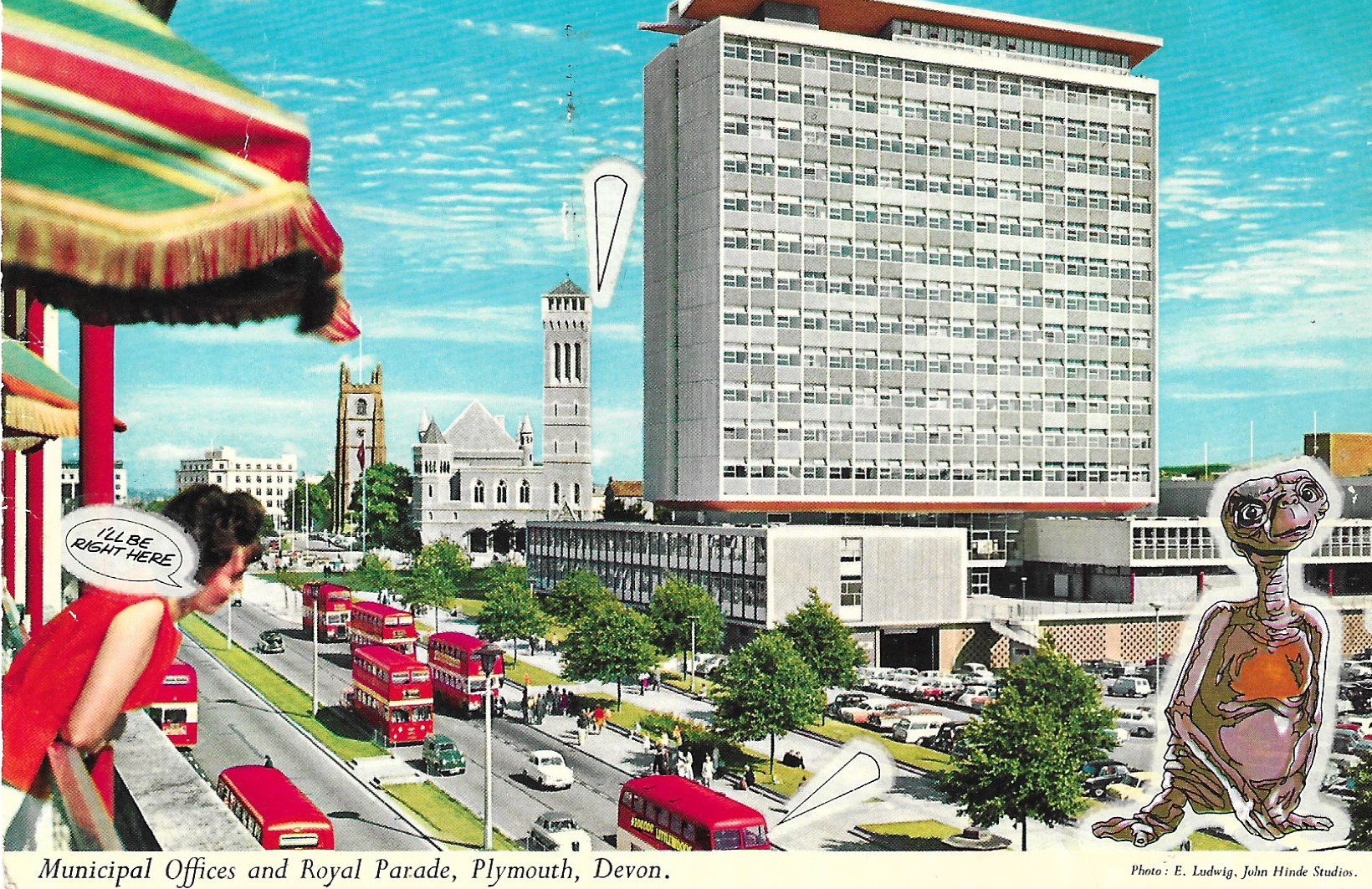
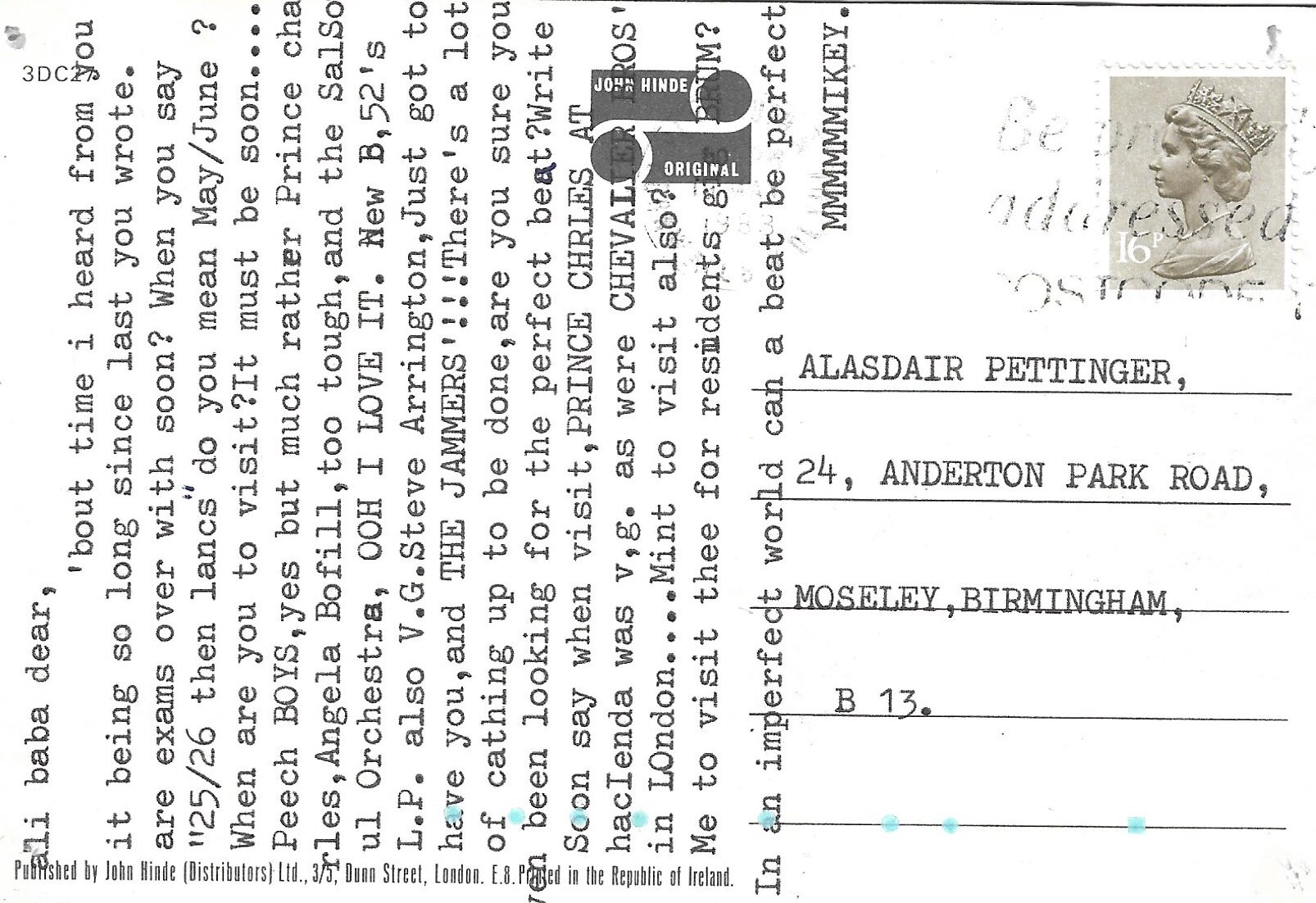
And I treasure another riposte of his I’ve kept, this one answering me, after I enthused about a new record I just bought, ‘Looking for the Perfect Beat’ by Afrika Bambaata. Typed on the back of a picture postcard featuring a laughably civic photo of Plymouth city centre, which he carefully defaced with inappropriate stickers, he seeks clarification of our summer plans, and bombards me with the music he’s been listening to: Angela Bofill, Prince Charles and the Beat Band, The SalSoul Orchestra, Steve Arrington, The Jammers, The Chevalier Brothers. ‘You sure you’ve been looking for the perfect beat?’ he asks. And then, in closing, another rhetorical question: ‘In an imperfect world, can a beat be perfect?’ Something I have pondered many times over the years.
He especially enjoyed springing his erudition on the unwary. Once, when we were hitch-hiking to Glencoe, drenched to the skin after an hour on the slip road and a sleepless night at a service station, we were picked up by a suit in a posh car. As we bundled ourselves and our rucksacks in the back seat, Mike recognised Beethoven on the radio. In his plummiest voice he boomed, as the Audi rejoined the carriageway, ‘Just in time for the minuet from the 8th symphony!’
It was the Allegretto from the 7th, but I didn’t say anything. Facts were always secondary to the dramatic effect. And to be sure some of the stories he told were decidedly iffy. Though when I checked them out, even the weirdest ones usually checked out. Approximately. For he had a remarkable memory, when it suited him. Only a few weeks before he died – which soon seemed like an age ago – he was enthusing about W H Auden, reciting lines, word-perfect, from what he called ‘that triumph of populism’, The Night Mail.
Speaking at the funeral, I would conclude with a poem. But no, not by Auden, not that one, made famous by John Hannah – but one of Mike’s own, written in the second blush of fatherhood. It’s called ‘Year Dot (after Sylvia Plath)’.
Thus the blues – ‘the black slave lament’ – was offered up for the admiration of the oppressors.
Frantz Fanon, ‘Racism and Culture’ (1956) in Toward the African Revolution, trans. Haakon Chevalier (Harmondsworth: Penguin, 1970), p. 47.
A Bard’s Ransom
It is curious, as Stephen Mullen recently observed, that Robert Burns – who never went to Jamaica – has somehow come to stand in for the thousands of Scots who did in the second half of the eighteenth century.1 Yet it is perhaps not surprising given the way Burns (to an extent hardly matched by any other poet) has been regularly hauled before the court of critical opinion and questioned about his life choices.2 Even tributes to Burns are typically expected to begin by admitting his (moral or political) shortcomings before dwelling more extensively on his (literary) talents. That he even contemplated going to the West Indies – and in a letter rather flippantly imagining an alternative future as a ‘poor Negro driver’3 – has been enough for many to channel disquiet about a vast and enduring transatlantic system onto a single, celebrated individual.
At some point in the legal proceedings, someone is bound to step up in Burns’ defence waving Exhibit A. And just as – in the wider historical debate – any claim that Scotland was complicit in the development and expansion of colonial slavery is often met with the counter-claim that, ‘Ah yes, but we also abolished it,’ so the case for the poet’s prosecution is supposed to collapse in the face of ‘The Slave’s Lament’, the song he is believed to have composed, and which was first published in 1792.
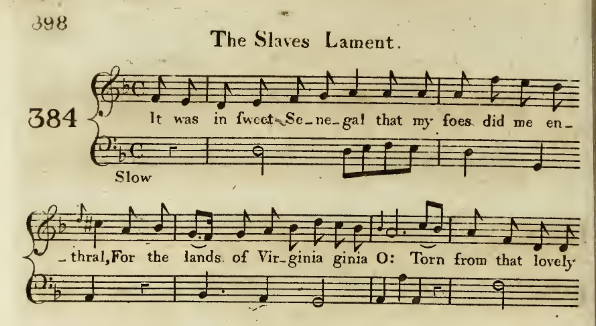
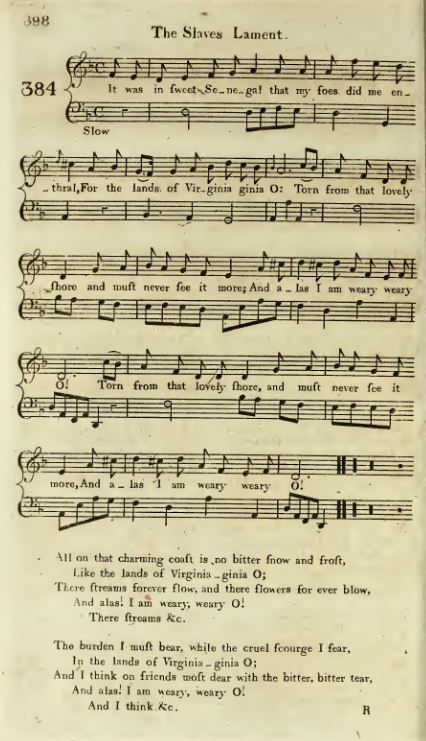
It was in sweet Senegal that my foes did me enthral,
For the lands of Virginia ginia O:
Torn from that lovely shore and must never see it more;
And alas I am weary weary O!
All on that charming coast is no bitter snow and frost,
Lie the lands of Virginia ginia O;
There streams forever flow, and there flowers for ever blow,
And alas I am weary weary O!
The burden I must bear, while the cruel scourge I fear,
In the lands of Virginia ginia O;
And I think on friends most dear with the bitter, bitter tear,
And alas I am weary weary O!
The song appeared in the fourth volume of the six-volume collection, The Scots Musical Museum, put together by the Edinburgh engraver and music-seller James Johnson.4It’s a moving lyric, to be sure, written from the point of view of one captured in West Africa to be enslaved in North America, bearing the burden while mourning the separation from loved ones back home. And it is regularly cited as a ‘get-out clause’ in response to those troubled by Burns’ colonial intentions.5 He was an abolitionist after all, they say. For many readers and listeners, then, the song itself seems to bear a burden: their own longings for something that offers, in Carla Sassi’s striking phrase, ‘a possibility of ransom from Scotland’s history’s darkest chapter.’6
Whose Song is it Anyway?
If ‘The Slave’s Lament’ is a ransom payment, the recipient might well feel short-changed. Set alongside other abolitionist verse of the period, the song – arguably – resembles less those that celebrate resistance than those that represent the enslaved ‘as helpless and supplicating’.7 Its model seems much closer to Wedgwood’s famous medallion, described by Marcus Wood as ‘the central icon of slave passivity and disempowerment’8 (distributed in Scotland the year the song was published)9 than, say, the statue of the Marron inconnu that stands in Port-au-Prince marking the Haitian revolution (which began the year before).
Michael Morris, in his sustained interrogation of Burns’ relationship to slavery and abolitionism, contrasts ‘The Slave’s Lament’ with Slavery: An Essay in Verse, a passionate twenty-page denunciation of the plantation system written by Burns’ exact contemporary, John Marjoribanks from Kelso who did go to Jamaica and served there as an infantry officer.10 No wonder then that Gerry Carruthers has dismissed it as ‘tame’ and ‘insipid’11 and as a single, ‘solitary item serves only to highlight how little interest [Burns] took in the pro-abolitionist cause, unlike many other Whigs of radical bent during the period.’12
But if this relies on a rather narrow model of what ‘radical’ poetry or song is, the ‘ransom’ falls short in another way. For evidence for Burns having written the song is weak. Carruthers suggests that ‘it is possible that Burns merely collected the song when scraping the barrel to send Johnson material’.13 Nigel Leask concurs: ‘Unfortunately there is no sure evidence that the song was written, rather than collected by Burns.’14 In this they follow editors James Kinsley, who notes that Burns’s ‘part in this song is uncertain’, and Donald Low, who cautiously remarks that it is ‘possibly not his work.’15
When James Currie (another Scot who ‘nearly went to Jamaica’, in his case as a surgeon)16 was leafing through the hundreds of songs Burns supplied to the Museum he may have paused when he came across ‘The Slave’s Lament’, not least because he himself had composed, with William Roscoe, a song they originally entitled ‘The Negroe’s Complaint’ (published pseudonymously as ‘The African’ in 1788).17 But he chose not to include it among the several dozen songs in the Works of Robert Burns he published in 1800.18 He may have had doubts regarding its authorship. More decisively, it may have lacked what Currie believed were the distinctive features of Burns’s songs, which, for him, typically depicted scenes of rural courtship in recognisably Scottish settings.19 And for many years, nothing more was claimed for the song than (as William Stenhouse remarked in his notes to the 1839 edition) it was ‘communicated by Burns to the Museum.’20
As far as I know, the first time it was included in collections of the poet’s works was in the Life and Workscompiled by Robert Chambers in 1851, but even then it was, as it were, quarantined in a section entitled ‘Old Songs Improved by Burns from Johnson’s Museum’ and Chambers acknowledges the reluctance to ‘assign this song to Burns’. However, he believes that ‘his authorship of it is much fortified by its resemblance to another song of his, entitled The Ruined Farmer’s Lament, which seems to have been formed on the same model.’21 The resemblance is slight, but it helped to shoe ‘The Slave’s Lament’ into the Burns canon, and the song regularly appears in editions of his works thereafter.
Of the author of this sweet song I can give no account. It is generally believed to be expressed in something like the simple language of that hapless race who were for so many centuries condemned by European avarice to perpetual slavery. The air too is supposed to be of African extraction. Indeed, the slaves in the West Indies have a remarkable taste for music; and every step they take, and every task they perform, is accompanied by song.22
By emphasising the uncertain origin of ‘The Slave’s Lament’, Cunningham is able to coax the reader who might skip over his qualifications (‘believed to be … supposed to be’) into imagining that it is an authentic slave song, sung not only to an ‘African’ melody but its words ‘too’ originally ‘expressed in … the simple language of that hapless race.’ As if it was based on the transcription of the singing of an actually enslaved person. An untutored cousin of Phillis Wheatley, perhaps, who like her was kidnapped in ‘Senegal’, but ended up in the fields of Virginia rather than the genteel homes of Boston, Massachusetts.23
After all, this period of the song’s anonymity coincides with the rise and fall of anti-slavery activity in Scotland, from Dickson’s tour of 1792 to the visits of Frederick Douglass, William Wells Brown and others in the 1840s and 50s.24 The movement, though best known, especially in Britain, for its white leaders (William Wilberforce, Thomas Clarkson) prized the testimony of the enslaved, and autobiographical narratives and lecture tours by Black men and women (when appropriately managed) formed an important part of the campaign’s rhetorical armoury. By the middle of the century popular demand for this testimony had fallen considerably, and the travesties of blackface minstrelsy seeped into even ostensibly abolitionist works such as Uncle Tom’s Cabin, particularly the theatrical adaptations that flourished in the decade before the Civil War.
From Poem to Song
Although ‘The Slave’s Lament’ was printed regularly in collections of Burns’ works from the 1850s, editions that included the melody were few and far between and for a long time hard to obtain. The situation improved with the republication of Robert Dick’s Songs of Robert Burns (1903) in 196225 and the appearance of Kinsley’s edition of the Poems and Songs in 1968, but the song never entered the repertoire of those renowned for their interpretation of Scots song for another two decades.
Only after Jean Redpath recorded it in 1981 as part of the ambitious Burns song project of Serge Hovey – based on many years’ research and featuring finely-crafted arrangements26 – did other singers begin to take notice.27
The song no doubt acquired new listeners when it featured in various art installations by Graham Fagen, which explored historical connections between Scotland and the Caribbean. Perhaps best known is the exhibit made for the Venice Biennale in 2015 (subsequently touring widely) which included a video projection of a specially-arranged string version by the composer Sally Beamish with the reggae singer Ghetto Priest.
All this not only put the song into much wider circulation, but also cemented its association with Robert Burns who is typically identified unproblematically as the author in the accompanying material. Sometimes this has been assisted by (unsupported) anecdotal claims that Burns wrote the song after seeing a slave ship in Dundee – a story heard by Sheena Wellington and printed in the sleeve notes to the live album on which her recorded version appears.29
Return to Source: The New Oxford Burns
By the first decade of this century, ‘The Slave’s Lament’ was pretty well established as a Burns song. Scholars would occasionally warn that the evidence of authorship was by no means settled, but their voices were seldom heard.
And now, with the new edition of the Scots Musical Museum, forming Volumes II and III of the recent Oxford Edition of the Works of Robert Burns (2018) perhaps they may be definitively silenced. For this edition Murray Pittock adopted an eight-fold system of classification (I to VIII) in an attempt to establish the degree to which Burns was involved as author and editor of each song. ‘The Slave’s Lament’ he assigns to ‘Category I [‘A song wholly by Burns, with no prior antecedents identified, or suspected’)] or Category III [‘A song significantly by Burns, with only isolated lines or a combination of phrases, subject matter, and tune evident from earlier evidence’’]’.30
That ‘Category I’ is considered a possibility is curious given that most of the editorial note that ends with this categorisation is concerned precisely with ‘prior antecedents’ of the song. As indeed Pittock (and the editors before him) does with most of the songs in the Museum, demonstrating that they did not spontaneously erupt from the imagination of the poet but were born of protracted immersion in the song culture of the eighteenth century, both in print (studying chapbooks, broadsides and bound collections) and orally (learning songs and tunes he heard sung and played by people he knew or met, either close to home or on his travels round the country).
In the case of ‘The Slave’s Lament’ the earliest attempt to identify an antecedent was by Charles Kirkpatrick Sharpe in the 1839 edition of the Museum where he writes: ‘I believe that Burns took the idea of his verses from “the Betrayed Maid,” a ballad formerly much hawked about in Scotland’, which he transcribes ‘from the stall copy’.31 A few decades later, the editors of The Poetry of Robert Burns (1897) added: ‘But Sharpe had no direct proof that this “stall copy” was older than the Burns. It may be that older it is, and that Burns used it; but the original is certainly a blackletter broadside, The Trappan’d Maiden, or The Distressed Damsel’.32That this was an important source for ‘The Slave’s Lament’ would seem to be confirmed by both Dick (1903) and Kinsley (1968) and in the new Oxford Edition Pittock finds it a ‘plausible’ claim.33
’The Trappan’d Maiden’ – facsimiles of copies dating from the late seventeenth / early eighteenth century may be viewed in the English Broadside Ballad Archive and the Bodleian Library’s Broadside Ballads Online – runs to sixteen verses and begins:
Give ear unto a Maid,
That lately was betray’d,
And sent into Virginny O:
In brief I shall declare,
When that I was weary, Weary, weary, weary, O.
As a first-person tale of enforced exile, and with its rhyme of ‘Virginny O’ and ‘weary O’, the similarities with ‘The Slave’s Lament’ are evident.34 But one striking difference, which no-one had made much of till now, is that the speaker in the broadside ballad is no African. As the prefatory note makes clear, ‘This Girl was cunningly trapann’d / Sent to Virginny from England.’ Pittock’s annotations probe deeper, drawing attention to a variant, ‘The Virginian Maid’s Lament’ included in Ancient Ballads and Songs of the North of Scotland (1828) and the note thereon by Peter Buchan.35 Buchan situates the Lament thus:
The practice of kidnapping, or stealing children from their parents, in the north of Scotland, from 1735 down to 1753, a period of eighteen years inclusive, and selling them for slaves to the planters of Maryland, Virginia, &c in North America, is too notorious to require any illustration here.
But not so notorious to prevent him to going on at great length to narrate the story of Peter Williamson, quoting a long extract from his autobiography.36
That Buchan calls the victims of such practices ‘slaves’ was certainly not exceptional for his time, but the use of the term ‘slavery’ to refer indiscriminately to a wide range of economic, social, political and legal injustices was contested vigorously by those of his contemporaries committed to the struggle to abolish the very particular institution of chattel slaveryin the Americas in the nineteenth century. They were all too well aware of the ways in which those who defended that institution were quick to seize on any excuse to deny the unique features of a transcontinental economic system based on human beings made the property of others. There are many who are worse off than the black slave, they would say. In a speech in Paisley in 1846 Frederick Douglass called this use of the term ‘slavery’ an ‘awful misnomer’.37 And it’s a point that needs to be repeated today as the flag of the ‘white slave’ (often ‘Scottish’ and ‘Irish’) is regularly raised in attempts to discredit anti-racist scholarship and activism.38
In the circumstances, then, Pittock’s suggestion that the ballad ‘does not seem to deal with African but with white slavery’ – uncritically adopting the terminology used by Buchan (without even the caution of quotation marks) – is injudicious, to say the least. The smirring of two very different forms of exploitation then makes it easy to dismiss the significance or emotional weight of ‘Senegal’ in the ‘The Slave’s Lament’ itself. Pittock concludes:
The final stanza of the Burns song makes clear that the woman who is lamenting ‘on friends most dear’ sounds more like a Jacobite exile than an African, who has suffered the fate of many of her fellow from the north-east of Scotland in the 1730-60 era, who were trafficked and sold ‘for slaves to the planters.’39
Conclusion: Restoring Strangeness to ‘The Slave’s Lament’
That the words of ‘The Slave’s Lament’ clearly owe something to ballads like ‘The Trapann’d Maiden’ has led editors and others to focus on the similarities rather than the differences, which rather conceals the work of transformation that turned one into the other. And unless we turn up other poems or songs in broadsides or printed collection that more closely resemble the one in the Scots Musical Museum, we must assume with some certainty that this work of transformation was ’significantly by Burns’, as Pittock’s second and more plausible categorisation has it. But why then belittle his input to the replacement of ‘England’ (in ‘The Trapann’d Maiden’) or ‘Scotland’ (in ‘The Virginian Maid’s Lament’) with ‘Senegal’ – and further diminish even this change as superficial by implying that ‘The Slave’s Lament’ is really about the tribulations of the Scottish diaspora, and not ‘about’ (chattel) slavery at all?
Why not both? Why not tease out the friction that comes from rubbing the two worlds of experience together, recognising certain similarities – even the possibilities of solidarity and collective resistance between them40 – without collapsing them in an unhelpful generic all-encompassing ‘slavery’ tag? It is possible to situate the song (as Carol McGuirk does) in the context of other verses by Burns on the theme of involuntary exile in a way that respects its difference: ‘Other exiled hearts speak not across time but from cultures far removed from Scotland’.41
And we might too pay more attention to the relationship between ‘The Slave’s Lament’ and other abolitionist verse of the 1790s – looking at not only differences of form but also of its place in print culture. Not in order to trace lines of influence necessarily but in an attempt to register how – on the page of the Scots Musical Museum – the lyric sounded to contemporary readers, familiar with abolitionist verse and other campaign material. Did they find it ‘in tune with growing and widespread unease’ about the slave trade, debated in the House of Commons at the time, as Robert Crawford suggests?42 Or did it strike a jarring or at least unexpected note?
For this reason (and having mentioned Phillis Wheatley earlier) it might be an instructive exercise to place ‘The Slave’s Lament’ alongside to her famous poem. ‘On Being Brought from Africa to America’, first published in her Poems on Various Subjects, Religious and Moral (1773).43
’Twas mercy brought me from my Pagan land,
Taught my benighted soul to understand
That there’s a God, that there’s a Saviour too:
Once I redemption neither sought nor knew.
Some view our sable race with scornful eye,
‘Their colour is a diabolic die.’<
Remember, Christians, Negros, black as Cain,
May be refin’d, and join th’ angelic train.
Without making any assumptions that Burns was familiar with the poem, consider how the Middle Passage in one is figured in religious terms (as a journey from paganism to Christianity) in contrast with the dominantly climatic and adversarial frame of reference in the other (as a journey from warm to cold, from ‘friends’ to ‘foes’); the shift from an expression of thanks to what it has made possible to a mourning of what – and who – has been left behind.
But what is more important perhaps is the turn half-way through Wheatley’s poem where the poet switches from narrating a personal experience to name and address her oppressors (‘Remember, Christians’) on behalf of her fellows (‘our sable race’) to vigorously proclaim their collective humanity. There is no corresponding switch in ‘The Slave’s Lament’ which remains in the first person singular throughout. And if the objectified ‘me’ in the first verse becomes a more expressive ‘I’ in the third, it is still an ‘I’ that ‘must bear’ and ‘fear’ the toil and punishments of the plantation, while those who wield the ‘scourge’ are unspecified and therefore unable to be rebuked.
Yet there is something forceful in the closing assertion that the eponymous ‘slave’ is capable of thought and feeling, and perhaps in the many repetitions of ‘I am weary’ in the chorus one might detect a hint of the singer’s frustration at having to tell their story over and over because no-one is really listening. Like Fannie Lou Hamer, ‘sick and tired of being sick and tired.’
As for the tune, the supposition that it was ‘an original African melody’ has been given short shrift by scholars, even if it continues to be repeated in sleeve notes.44 But the fancy did not just emerge from a romantic or abolitionist desire for the authentic or exotic. It does recognise something anomalous about the song – that it sounds different from the others in the Museum. Whether it is its even pacing or its harmonic progressions, the melody has characteristics that set it apart from what is generally felt to be characteristic of Scots song. Martin Carthy reports, when told it was a Burns song on first hearing it, ‘I did think, “Oh yeah?”’
The song chooses to render the experience of slavery as a ‘lament’ rather than as a ‘complaint’, a related but more accusatory genre that was more commonly adopted in abolitionist verse.45 As such it seems to sit comfortably with the half-dozen poems or songs by Burns that have ‘lament’ in their title; and certainly the lament has deep roots in Scottish music. But the genre points us outward too – back to the baroque classical laments and forward (as several interpreters of the song recognise, because they inhabit musical worlds unknown to Burns) to African American spirituals and blues.
So we shouldn’t be so surprised that Serge Hovey thought the tune ‘has all the characteristics of a Jewish lamentation in the Ashkenazic Ahavoh-Rabboh mode.’46 Or that, intriguingly, Sheena Wellington reports meeting in Singapore an ‘anthropologist from Dorset who said […] it’s actually 12th, 13th century Spanish sephardic, “Rachel’s Lamentation”, and they know it in North Africa to a different rhythm’.47
As far as I know this speculation awaits more detailed research. Perhaps there is more in Hovey’s Robert Burns Songbook, 1200 pages of manuscript completed in 1973 that remains in private hands.48 Furthermore, no one has yet found it in any printed collection that Burns might have consulted and any plausible circumstance in which he might have heard someone playing or singing it remains hard to reconstruct.49 This absence is significant because, as Kirsteen McCue has pointed out, the words to the songs he wrote were ‘most often inspired by a melody. Indeed Burns noted that he had to know a tune intimately before beginning to write a lyric for it.’50
There are many unknowns about ‘The Slave’s Lament’. There is so much more to find out. But if we resist the temptation to treat it primarily as evidence to be produced in defence of an individual’s character – or (even worse) to offer it by way of compensation for what has been called ‘Scotland’s hidden shame’ – we are more likely to appreciate the manifold musical, literary and historical forces that have combined to shape and re-shape the song, before and after its appearance in the Scots Musical Museum. It is time to rediscover a certain haunting strangeness in ‘The Slave’s Lament’ that those who perform it often capture so well.
Notes
This is a work in progress (last revised 9 Apr 2021). Comments welcome.
For estimations of figures see Douglas J. Hamilton, Scotland, the Caribbean and the Atlantic World 1750-1820 (Manchester: Manchester University Press, 2005), pp. 22-25.
‘The issue of whether the poet was (or was not) an admirable person … places the critic as moral judge in a recurring trial where Robert Burns is perpetual defendant’: Carol McGuirk, ‘The Politics of The Collected Burns,’ Gairfish: Discovery, ed. W.N. Herbert and Richard Price (Bridge of Weir: Gairfish, 1991), p. 36.
Robert Burns to John Moore, Mauchline, 2 August 1787 in The Letters of Robert Burns, ed. G. Ross Roy (Oxford: Clarendon Press, 1985), Vol. 1, p. 144.
‘The Slave’s Lament’, in The Scots Musical Museum Vol. IV, ed. James Johnson (Edinburgh: Johnson & Co, 1792), p. 398.
Nigel Leask, ‘“Their Groves o’ Sweet Myrtles”: Robert Burns and the Scottish Colonial Experience’ in Robert Burns in Global Culture, ed. Murray Pittock (Lewisburg, PA: Bucknell University Press, 2011), p. 178.
Carla Sassi, ‘Acts of (Un)willed Amnesia: Dis/appearing Figurations of the Caribbean in Post-Union Scottish Literature’ in Caribbean-Scottish Relations : Colonial and Contemporary Inscriptions in History, Language and Literature , ed Giovanna Covi, Joan Anim-Addo, Velma Pollard and Carla Sassi (London: Mango, 2007), p. 172.
The range of late 18th- and early 19th-century verse is discussed by Alan Richardson in his introduction to his anthology, Slavery, Abolition and Emancipation: Writings in the British Romantic Period, Volume 4: Verse (London: Pickering and Chatto, 1999).
Marcus Wood, ‘Popular Graphic Images of Slavery in Nineteenth-Century England’ in Representing Slavery: Art, Artefacts and Archives in the Collections of the National Maritime Museum, ed. Douglas Hamilton and Robert J. Blyth (Aldershot: Lund Humphries, 2007), p. 144.
Iain Whyte, Scotland and the Abolition of Black Slavery, 1756–1838 (Edinburgh: Edinburgh University Press, 2006), esp. pp. 74–78.
Michael Morris, Scotland and the Caribbean, c.1740–1833: Atlantic Archipelagos (New York: Routledge, 2015), pp. 98-131, esp. 115–19. See also Karina Williamson, ‘The Antislavery Poems of John Marjoribanks,’EnterText, Vol. 7, No. 1 (2007), pp. 60-79.
Gerard Carruthers, ‘Robert Burns and Slavery’, The Drouth 26 (2007), p. 23.
Gerard Carruthers, Robert Burns [2006] (Liverpool University Press, 2018), p. 60. Nigel Leask pursues this more fully in ‘“Their Sweet Groves”’.
Carruthers, ‘Burns and Slavery,’ p. 23
Leask, ‘“Their Sweet Groves”, p. 178.
Robert Burns, The Poems and Songs of Robert Burns, ed. James Kinsley (Oxford: Clarendon Press, 1968),Vol. 3, p. 1405; Robert Burns, The Songs of Robert Burns, ed. Donald Low (London: Routledge, 1993), p. 547.
Robert Donald Thornton, James Currie: The Entire Stranger and Robert Burns (Edinburgh: Oliver & Boyd, 1963), pp. 92–4. As a younger man, however, he was employed as an apprentice by William Cunninghame & Company on their tobacco plantations in Virginia. Ibid., pp. 32–66.
Thornton, James Currie, p. 191. For the words of the song and further details, see William Wallace Currie, Memoir of the Life, Writings and Correspondence of James Currie, M.D. F.R.S. of Liverpool (London: Longman, Rees, Orme, Brown and Green, 1831), Vol.1, pp. 127–35. It is also reprinted, as ‘The African’, in Richardson, Slavery, Abolition and Emancipation, pp. 99-100.
James Currie, The Works of Robert Burns; with an account of his life… (Liverpool: J. M’Creery, 1800), 4 vols.
For Currie’s assessment of Burns’s songs, see esp Works, Vol. 1, pp. 323-30.
William Stenhouse, ‘Illustrations of the Lyric Poetry and Music of Scotland, Part IV’ in The Scots Musical Museum Vol. IV, ed. James Johnson (Edinburgh: William Blackwood, 1839), p. 353. Stenhouse’s notes were subsequently published separately in 1853.
Life and Works of Robert Burns, ed. Robert Chambers (Edinburgh: W. and R. Chambers, 1851), Vol. IV, pp. 267–68.
Allan Cunningham, Songs of Scotland, Ancient and Modern… (London: John Taylor, 1825), 4 vols, Vol. II, pp. 223–24. Fourteen years later Stenhouse repeats the supposition that ‘the air … is an original African melody’, (‘Illustrations,’ p. 353) ensuring that it enjoyed wide circulation.
Although it is popularly believed that Wheatley came from Senegal or thereabouts, the location of her birthplace or even where she was forced on board the slave-ship, is uncertain. See Vincent Carretta, ‘Phillis Wheatley: Researching a Life,’ Historical Journal of Massachusetts, Vol. 43 No. 2 (2015), esp. pp. 70–1.
The best survey of this activity is Whyte, Scotland and the Abolition of Black Slavery.
James C. Dick, The Songs of Robert Burns [1903] (Hatboro’, PA: Folklore Associates, 1962).
See Kirsteen McCue. ‘“Magnetic Attraction”: The Transatlantic Songs of Robert Burns and Serge Hovey.’ in Robert Burns and Transatlantic Culture , ed. Sharon Aiker, Leith Davis and Holly Faith (London: Routledge, 2012), pp. 233-247.
Sheena Wellington remarked: ‘I first heard the poem from my father when I was about 9 and nearly cried but as “snivelling” was not encouraged in our house I went and learned the poem by heart instead. I don’t think I ever heard a tune to it until Jean Redpath recorded it’. Quoted in Valentina Bold, ‘The Slave’s Lament’, a talk delivered at Wigtown Book Town Festival, 2007, with Kathy Hobkirk performing the song.’, p. 13. This talk is the most detailed study of the song to date, and especially valuable for what it reveals of how singers themselves have responded to ‘The Slave’s Lament.’
Quoted in Bold, ‘The Slave’s Lament,’ p. 8.
Sheena Wellington, Strong Women (Greentrax CDTRAX 094) (1995), For further reflections on this story see Bold, ‘The Slave’s Lament’, p. 4.
The Oxford Edition of the Works of Robert Burns. Vols II and II: The Scots Musical Museum, ed. Murray Pittock (Oxford: Oxford University Press, 2018), Vol. III, p. 142 . The categories themselves are defined in Vol. II, p. 12, where it is stated that only those in Category I through to V ‘deserve a full place in the Burns canon’.
C. K. Sharpe, ‘Additional Illustrations,’The Scots Musical Museum Vol. IV, ed. James Johnson (Edinburgh: William Blackwood, 1839), pp. 389-91. In some accounts of the history of ‘The Slave’s Lament’ Sharpe is confused with the English folk-song collector Cecil Sharp.
The Poetry of Robert Burns, ed. William Ernest Henley and Thomas F Henderson (Edinburgh: T C and E C Jack, 1897), Vol. III, p.393.
The Songs of Robert Burns, ed. James C. Dick (London: Henry Frowde, 1903), p. 479; Robert Burns, The Poems and Songs of Robert Burns, ed. James Kinsley, Vol. 3, p. 1405; The Oxford Edition, Vol. III, p. 141.
On the recurrent theme of ‘involuntary exiles’ (of all kinds) in Burns poems and songs see Carol McGuirk, ‘The Crone, the Prince, and the Exiled Heart: Burns’s Highlands and Burns’s Scotland’, Studies in Scottish Literature, Vol. 35, No. 1 (2007), pp. 184–201.
Ancient Ballads and Songs of the North of Scotland, ed. Peter Buchan (Edinburgh: W & D Laing, and J Stevenson, 1828), Vol II, pp. 215-17, 332-35.
Oxford Edition, Vol. III, p. 141. Note also the assumption that the singer is a woman, casting aside the change from the gendered ‘maid’ or ‘maiden’ to the ungendered ‘slave’.
See, for example, Peter Linebaugh and Marcus Rediker, The Many-Headed Hydra: The Hidden History of the Revolutionary Atlantic (London: Verso, 2000).
McGuirk, ‘The Crone, the Prince, and the Exiled Heart,’ p. 199. How ‘far removed’ Senegal and Virginia were ‘from Scotland’ in the 1790s remains an interesting question.
Robert Crawford, The Bard: Robert Burns, a Biography (London: Pimlico, 2010), p. 352.
Phillis Wheatley, Poems on Various Subjects, Religious and Moral (London: A. Bell, 1773), p. 18.
In 1903 Dick was rather sceptical (Songs of Robert Burns, p. 479); and more recent editors have rubbished the claim as ‘nonsense’ (Kinsley) and ‘ridiculous’ (Pittock).
‘Complaint’ appears in the title of several poems – not only Currie and Roscoe’s ‘The Negroe’s Complaint’ (1788) (already mentioned) but also William Cowper’s more famous poem with the same title (1788), and an anonymous ‘The African’s Complaint On Board a Slave Ship’ (1793). But note also ‘The Sorrows of Yamba; or, the Negro Woman’s Lamentation’ (1795), possibly the work of Hannah More. All are reprinted in Richardson, Slavery, Abolition and Emancipation.
CD booklet, Jean Redpath, The Songs of Robert Burns, Volumes 3 & 4 (Greentrax CDTRAX 115, 1998) (Volume 3 on which ‘The Slave’s Lament’ appears was originally released on LP as Philo 1071 in 1981).
Quoted in Bold, ‘The Slave’s Lament,’ p. 14.
McCue. ‘“Magnetic Attraction”’, p. 237.
The versions of ‘A Trappan’d Maiden’ Burns may have seen were not printed with the melody, and the words would not have fitted the tune in the Museum in any case, so it’s unlikely he came across the melody in that quarter.
Kirsteen McCue, ‘Burns’s Songs and Poetic Craft,’ The Edinburgh Companion to Robert Burns, ed. Gerard Carruthers (Edinburgh: Edinburgh University Press, 2009), p. 75.
For a period of over fifty years, many thousands of people were conscripted to be exhibited as caricatures of themselves in the various world fairs, mostly in Europe and North America. They came from Africa, Asia, the Pacific and the Arctic. One of the first was the ethnic village at the Paris World Fair in 1878; and these so-called ‘human zoos’ were staged frequently until at least the Second World War.
From contemporary documents we know something of the way these events were planned and managed, and the reactions of visitors. But very little testimony of the people on show have made their way into print. A notable exception is the diary of Abraham Ulrikab, the father of one of two Inuit families who were taken to Hamburg in 1880 and who embarked on a tour of several European cities that winter during which they all died of smallpox because their handler forgot to vaccinate them.
This book concerns the Colonial Exhibition held in Paris in 1931. It offers a fictional reconstruction, narrated by Gocéné, one of the Kanaks shipped from Melanesia to people an ethnic village. While Daeninckx gives Gocéné every opportunity to dwell on their appalling treatment by the organisers, he chooses to avoid portraying him as a hapless victim of circumstance. Most of the novella takes the form of a thrilling adventure, which ensues when he and his friend Badimoin hear that some of their compatriots have been selected to be taken on a bus tour of city. Distressed at their unannounced departure – especially because Badimoin’s cousin Minoé is among them – the two friends decide to escape from the Exhibition and try to catch up with them.
Their unfamiliarity with Paris – they come across a Metro station but are hesitant to descend into the unknown, for example – makes Gocéné’s narrative resemble those satires that render Europe strange in the tradition of Montesquieu’s Persian Letters. But the pace picks up as the two men hear that the sight-seeing tour was a ruse and that Minoé and the others were actually on their way to Germany (in a deal struck between the Exhibition organisers and a circus in Frankfurt).
They make their way to the Gare de l’Est where – after a bizarre encounter with a Salvation Army band – they arrive just too late to intercept the train. By this time the police are in hot pursuit and in the nick of time they are saved by Fofana, a Senegalese cleaner, who conceals them. When they ask why he helps them, Fafana explains how he always sides with the noirs when they are chased by the police and recalls how the white officers sent many of his comrades to their deaths in the trenches during the War. Out of immediate danger, they emerge from their hiding place and after learning that there is not another service to Frankfurt for several days, they return, disheartened, to the Exhibition.
The episode will end tragically, but not before the two friends are astonished to see a protestor gatecrash the compound and denounce the cruel charade of the exotic performance. Echoing the words of a famous tract printed at the time and signed by André Breton and others, she appeals to the visitors, ‘Don’t Visit the Colonial Exhibition’.
If Deaninckx is keen to emphasise the various ways in which both the Kanaks and Parisians resisted and challenged the Exhibition, he also situates the episode in a longer history. For the novella begins with Gocéné as an old man in the 1980s, back home in New Caledonia, in the midst of the armed struggle to win independence from French colonial rule. He tells the story to two rebels at a roadblock who want to know why he is travelling in a car with a white man. His companion, it turns out, played a decisive role in the events in Paris with which the novella culminates. And now, in his retirement, has succeeded in renewing his acquaintance with Gocéné, and has travelled to the Pacific to meet him.
In a later edition of the novella (which includes a sequel, Le detour d’Ataï) the author notes that just a few months after it was first published, the Kanak footballer Christian Karembeu was in the French team that lifted the World Cup at the Stade de France. His great grandfather was Willy Karembeu, who makes a cameo appearance in the book as he was one of those taken to Germany from the Exhibition in 1931.
In the text, some of the names have been changed to protect identities (Alain de Botton, A Week at the Airport)
Most of the names in the book have been changed (Roger Green, Destination Nowhere).
Minor Characters and Travel Writing
We’re all familiar with this disclaimer – or something similar – that appears at the front or back of certain works of non-fiction.
On the one hand, it is a way of reminding us that this indeed is a work of non-fiction. It would sound ludicrous in a novel, at least a highly imaginative one. ‘Harry Potter (not his real name)…’ It is saying: the people who appear in this book are not made up, they really have an independent existence. People who know them – friends, enemies – may well be reading this book.
On the other hand, by admitting that their names have been changed, the writer (or publisher) is already alluding to a process of fictionalization. And one which, we must assume, does not stop at names. In order to protect the privacy of an individual, it is likely one must adjust their place of residence or their job title, remove distinctive features of speech or appearance, and so on. A whole textual witness protection programme would seem to be required.
The practice of changing names is common in investigative journalism, where whistle-blowers need to be protected, or in certain kinds of confessional writing. In travel accounts, we come across it less often. For here, the first-person protagonist cuts a rather lonely figure. The minor characters who appear in the narrative are often very minor indeed, their purposes crudely instrumental. Even when the narrator explicitly engages them in conversation, the sense that they have life histories or powers of observation that would match the writer’s own is conspicuously lacking. The idea that other people might travel often seems particularly threatening.
One kind of travel narrative in which other people feature more strongly is the one in which the first-person protagonist remains stationary and focuses his or her attention on the comings and goings of everyone else. A genre that might be called travellee writing. Here, at last, perhaps, the minor characters may have a greater claim on our interest.
In this post I want to explore the the different ways transit-ing passengers, customers, guests – and their backstories – are brought to life on the basis of a very brief (and sometimes indirect) acquaintance, in three books of this type:
Destination Nowhere (2004) by Roger Green. A diary recording multiple visits to South Mimms motorway service station north of London over a year and a half.
L’Hôtel(1984) by Sophie Calle. Another diary, this one full of a housekeeper’s observations of rooms in a Venice hotel.
The first two of these (as I have indicated) employ such disclaimers. Sophie Calle’s book does not, but her text does redact the surnames of the hotel guests, which is a related practice.
I’m going to take one example from each book to indicate some of the ways in which minor characters are presented: the evidence on which their personality or history is – or is not – extrapolated; and the extent to which this involves some imaginative embellishment.
But, drawing on Alex Woloch’s richly suggestive study, The One Vs. the Many, I also want to insist that minor characters can’t really be understood on their own; their relationship with the protagonist is important.1 The protagonist needs minor characters in order to be, well, a convincing protagonist. How well they meet this need is an open question.
Alain De Botton
De Botton gives the people he meets quite detailed backstories. Sometimes these mini-biographies are explicitly hypothetical (where the intention seems to be simply to evoke a ‘type’ rather than accurately identify an individual). Occasionally the stories are more developed and idiosyncratic, suggesting that they derive from an actual conversation with the person in question. But it’s often hard to tell the difference.
Let’s take this passage.
A full 70 per cent of the airport’s departing passengers were off on trips for pleasure. It was easy to spot them at this time of year, in their shorts and hats. David was a thirty-eight-year old shipping broker, and his wife, Louise, a thirty-five-year-old full-time mother and ex-television producer. They lived in Barnes with their two children, Ben, aged three, and Millie, aged five. I found them towards the back of a check-in line for a four-hour flight to Athens. Their final destination was a villa with a pool at the Katafigi Bay resort, a fifty-minute drive away from the Greek capital in a Europcar Category C vehicle.
The detail here is so excessive, and though this family and their holiday are entirely plausible, it is difficult to imagine an interview that would yield so much information, unless it took place in a police station. It seems likely that if de Botton did meet someone matching the description of David and Louise, at least some of the ‘facts’ here have been supplied by the author. He continues:
It would be difficult to overestimate how much time David had spent time thinking about his holiday since he had first booked it, the previous January. He had checked the weather reports online every day. He had placed the link to the Dimitra Residence in his Favourites folder and regularly navigated to it, bringing up images of the limestone master bathroom and of the house at dusk, lit up against the rocky Mediterranean slopes. He had pictured himself playing with the children in the palm-lined garden and eating grilled fish and olives with Louise on the terrace.2
We have long since left behind anything that might have come out of a conversation and de Botton has entered the realm of the fictional with a third-person omniscient narrator who renders David’s thoughts and feelings in the language of an Anglo-Swiss philosopher (rather than reporting it in direct or free indirect speech that might have conveyed the more colloquial idiom Dave himself might have used).
Roger Green
If one can reconstruct a multitude of different stories from A Week at the Airport (from the businessmen who occupy the executive lounges to those who clean up after them) (and this is the one of the book’s great merits), they remain rather indistinguishable at the level of discourse. Their accents, idioms and idiolects disappear in the uniform narrative voice that is used to paraphrase them.
De Botton’s antithesis is Roger Green. While there are some silent encounters, by and large Destination Nowhere is a cacophony of different voices: sentences he overhears, dialogues in which he participates, and longer sections where he transcribes (and presumably abridges) the confessions of a few customers and staff who agree to be formally interviewed.
Here’s an extract:
‘He’s got the fucking key. Why can’t he open up?’
‘It’s what I’ve been telling you.’
‘He can’t do it.’
‘His company, his money.’
I arrive at the end of a mobile phone conversation.
The man in an olive-green shirt with a matching dark tie, and carefully groomed jet black hair, speaks directly at the man sitting across the table to him and down his mobile simultaneously. The second man in a dark off-the-rail Burton’s discount suit is quiet.
The ‘mouthy’ one reminds me of a younger Dave Bassett when he was manager at Wimbledon. You know, always up for it, talks bollocks, and is oblivious to those around him.
Lots of arm waving and ‘fuckings’ as they leave.
Sometimes I feel as if I am on the set of The Truman Show with Jim Carey [sic]. Is this an artificial world I am in?3
No names have been changed here, although one of the anonymous characters has been lent the name of a former football manager in an attempt to convey his manner. The phone transcript, the arrangement of the two men and their clothes, lightly suggest a possible backstory (or rather several possible backstories), but the scene more forcefully invites the reader to imagine what it feels like for the narrator-protagonist to observe and listen to them, well before the enigmatic closing paragraph. The scare-quotes around ‘mouthy’ suggest he is aware that a more sophisticated term might be more appropriate but cannot call it to mind. But then he throws caution to the winds in the strikingly vernacular gloss on his Bassett comparison that follows.
The passage well captures, I think, the slightly smug tone of the book’s narrator. But I think the documentary impulse gives us enough detail, gives the characters enough space, to make us wonder if Green isn’t being unduly dismissive here, drawing our sympathy to two men, particularly the silent companion.
Sophie Calle
Sophie Calle also adopts the diary format, but her entries are much more measured and meticulous than Green’s. First and foremost they describe rooms, almost as if they are unoccupied, like the opening directions for a scene in a playscript. But in this example the narrator’s presence is evident from the start.
Monday 2 March, 10.30am. I go in to 24, the pink room. The twin beds are unmade. A strange feeling of deja-vu. Images are jumbled. Days and guests blend into one another. Had I not already seen to these people? The first things I notice are the books on the table: The Colour Orange by Alain Gerber and a French-Italian dictionary. In the wardrobe: the ordinary clothes of a banal couple, camera equipment in a shoulder bag, an empty suitcase. The drawer is stuffed full of handkerchieves, insulin medication, Gauloises Caporal.
‘I enter’ and then – without using the first person – her subjectivity inflects most of the suceeding sentences (a sense of deja-vu, the way the days merge into each other) and we follow her gaze around the room (the books on the table, the clothes in the wardrobe, the contents of the drawer). A precision (make of cigarettes, the title of the book, the type of medicine) indicates a particular level of attention, and only the words ordinaires and banal betray any sense of judgement; they stand out from what seems to be a dispassionate inventory.
And then:
I empty the handbag on the floor: sachets of sugar, tampax, pink lipstick, postal orders in the name of Paulette B., old tickets for a Xenakis concert and a diary.
Calle, we might have guessed by now, is no ordinary housekeeper, and indeed appears to spend very little time actually cleaning the rooms, preferring, in fact, to search them. And of course the diary is too much to resist. So in her own diary Calle transcribes extracts from another:
On the first page I read: ‘In the event of my decease, everything I own is at the sole disposition of M. Francois G.’ and the signature of Paulette B., childish, touching. Under the heading ‘Notes’, this figure: 23, 485.68, the address of a retirement home in Versailles, a sentence: ‘A chamois of between a year and 18 months is called an éterlon,’ and a quotation from Malraux, which I decipher with difficulty. I think it says: ‘It was the first white civilization but it was also the glittering lagoon of a Maori world […] For us there is difficulty in associating the Iliad, or even the Odyssey, with these courts in which naked princes wearing ostrich-feather headdresses bowed their lances before Phedra-like grandes dames exhibiting their breasts above chastely billowing flounces of fine linen.’ A. Malraux, NRF, 1954, page 93.4
And the text continues a good while beyond this. Fragments from which one might begin to construct a character, but there is too much that is inscrutable. Calle makes no attempt to extrapolate Paulette B from these fragments; nor do they seem to be chosen in order to prompt readers to draw their own conclusions. In a sense, the actual contents of the diary – or indeed of the handbag – are irrelevant. The main point is Calle’s shocking willingness to pry: to exceed the bounds of what might be thought to be acceptable conduct on the part of both a housekeeper and a travel writer.
The Limits of Fabrication
The thing is, though. By the time she enters room 24 we’re more than half way through the book and have grown accustomed to her modus operandi. The way she opens drawers and luggage, and arranges belongings on the bed or floor in order to photograph them. The way she registers subtle differences from one day to the next, prompting the kinds of speculations one might expect from a private detective.
That she reports her investigations in such detail seems to be governed by the need to convince her readers that she actually did act so improperly, for her project is to expose and unsettle our preconceptions about the public and private. But the detail nevertheless exceeds this purpose.
The hotel guests, like Paulette B, remain elusive figures, but they occupy a disproportionate space in Calle’s discours than any histoire we might try to reconstruct from their fragments. Indeed, as you read on, Paulette B begins to nag like an unsolved crossword clue – as if, once her mystery has been cracked, she could be called on to appear in an alternative narrative in which she is the protagonist. (And Calle runs like hell once Paulette discovers she’s been reading her diary).
I think this is true – to a greater or lesser degree – of minor characters more generally. In other words, minor characters often seem to serve a merely instrumental role (providing local colour, acting as a mouthpiece for some contextual history, assisting or obstructing the traveller’s progress), ‘flat’ in order that the protagonist can be ‘round’. But at the same time, there is always a possibility that they are given too much space, that we get carried away by David and Louise or intrigued by the man in the green shirt – partly because we might feel that the text has been a little unfair to them. At which point the authority of the protagonist begins to falter.
In an interview Colin Thubron was asked about the role of fabrication in travel writing. In his reply he makes what is – I think – a fairly commonplace distinction.
On the one hand, he insists that a certain kind of fabrication is inevitable, even necessary in travel writing. He talks of himself of having ‘jumbled people’. Part of this is due to the imperfections of memory, but of course even if accurately remembered, a writer must choose what to leave in and leave out, to describe and interpret events in a particular way that betrays one’s ‘sensibility’ or ‘personality’. He also suggests that a deliberate falsification can be ‘useful in some ways. In the China book,’ he says, ‘I wasn’t sure if some people or myself were not being watched, so you displace them in the narrative to somewhere else.’
On the other hand, pressed by the interviewer, who asks about rather less acceptable forms of fabrication – specifically (and rather economically) ‘the temptation to make things up, or fudge quotes’ – the point at which, we might say, the novelistic techniques of characterisation have gone too far. Thubron admits the temptation but has never succumbed because he doesn’t think he could carry it off. ‘If someone were to say I’ve got to make up somebody I met, I wouldn’t know where to be begin – it would stand out like the most obvious fake.’
He continues:
I’ve got one or two friends who write about cultures that they really know – the States, for instance. And one friend – quite a well-known travel writer, I won’t mention his name – says it’s just a change of gear. He writes the facts, and then he goes up a gear and starts imagining from there on, and claims it’s fact. But for me, fiction is like getting into a different car. My imagination is working in a completely different way.5
We might note Thubron’s reluctance to make a moral judgement here. Making things up and fudging quotes are not wrong, just not the way he personally likes to work. But they are not quite equivalent alternatives, matters of taste. He feels compelled to introduce this minor character – whom he declines to name (which of course only makes us more curious) – who precisely does make things up and fudge quotes and claims it’s fact. In order to give his own way of doing things more integrity, he conjures up this reckless, speeding driver who breaks the limit with impunity, while casting himself as a more law-abiding motorist who – when he allows himself the thrill of speed – does so in a more appropriate vehicle, presumably in a safer place (like a race track).
A contrast which is highly moralistic. And yet, like any story that requires a villain, it is hard to stop that villain becoming lovable. After all, fast cars are frighteningly popular.
Notes
Based on a paper first presented at the Travel and Truth conference in Oxford, 16-18 September 2011.
Alex Woloch, The One Vs The Many: Minor Characters and the Space of the Protagonist in the Novel (Princeton: Princeton University Press, 2003).
Alain de Botton, A Week at the Airport: A Heathrow Diary (London: Profile, 2009), pp. 37-38.
Roger Green, Destination Nowhere: A South Mimms Motorway Service Station Diary (London: Athena, 2004), pp. 117-18.
Sophie Calle, L’Hôtel (Paris: Actes Sud, 1998), pp. 92-4. My translation, except for the quotation from Malraux, for which I used Stuart Gilbert’s translation of The Metamorphosis of the Gods, London, Secker, 1960, p. 41.