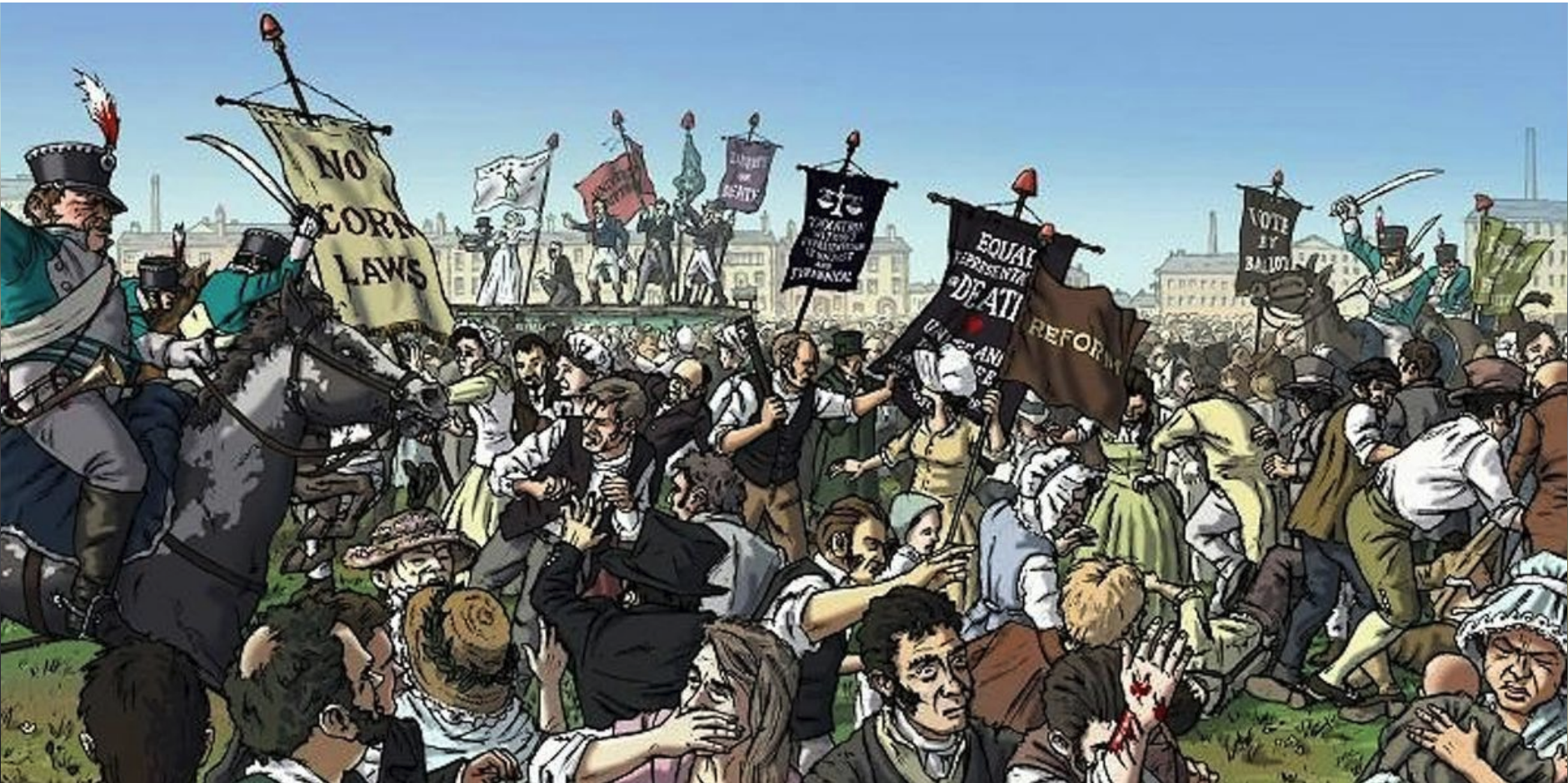
Bread and Fair Prices! No King – Liberty – Equality! Down with the Irish! More Meat and Fewer Cooks! Damn all Kings! No Militia! Annual Parliaments! The Rights of Man! For Trade We Mourn! Freedom to Ireland! Universal Suffrage! Union and No Stamps! Don’t Tread on Me! Undaunted by Tyrants, We’ll Die or Be Free!
Anyone familiar with the Age of Revolution in the English-speaking world will have come across utterances of this kind. But what kind of utterances are they? What should we call them?
Historians today are most likely to say slogans. A term that might fit them all. But they might also be designated mottoes or oaths, which would apply in some cases but not others. Each of these words has a distinct history and brings its own cluster of associations. Let us consult the dictionary.
- Slogan: from Scottish Gaelic (sluagh-ghairm: sluagh, host, gairm, cry or shout). First appearance in 16th C as slogorne, sloggorne, slughorn(e), beginning to be standardised as slogan from late 17th C. But not common until early 20th C. ‘A war cry or battle cry … usually consisting of a personal name or the name of a gathering place …’ and then (transferred) ‘The distinctive note, phrase, cry, etc of any person or body or persons; now esp a motto associated with a political party or movement or other group, or a short and striking or memorable phrase used in advertising.’
- Motto: from Italian (motto, short sententious phrase (a_1294), clever, witty saying (a_1321), poetic composition (14th cent.), word (a_1764, probably after French mot). Common from 16th C at least. (1) ‘Originally: a word, sentence, or phrase attached to an impresa or emblematical design to explain or emphasize its significance. Later also: a short sentence or phrase inscribed on an object, expressing a reflection or sentiment considered appropriate to its purpose or destination; a maxim or saying adopted by a person, family, institution, etc., expressing a rule of conduct or philosophy of life.’ (2a) ‘Heraldry. A word or sentence of special significance to the bearer usually placed on a scroll either below an achievement of arms or above the crest. Most often the scroll bears a maxim, etc., adopted by the bearer (or sometimes, as a riddle, the initial letters of such a maxim). Other mottos arise from war cries or simply have some reference to the name or exploits of the bearer, the charges on the shield, or the crest.’ And from early 18th C, (2b) ‘A short quotation or epigram placed at the beginning of a book, periodical, etc.; an epigraph’.
- Oath: from Germanic. Appearing in English as eth, eith, aithe from 15th C then oth(e) in 16th C and oath from 17th C. Very common, but declining gradually through 19th and 20th C. ‘A solemn or formal declaration invoking God (or a god, or other object of reverence) as witness to the truth of a statement, or to the binding nature of a promise or undertaking; an act of making such a declaration. Also: the statement or promise made in such a declaration, or the words of such a statement.’
Note that slogan has expanded its meaning over the years, and now overlaps considerably with motto. A slogan nowadays may take a written as well as oral form, but the term is usually restricted to informal, often short-lived, chants or inscriptions (scrawled on walls, on placards, on makeshift flags, even on human bodies), while motto is usually reserved for more formal, and more enduring, printed manifestations.1 Both are characterised by their brevity; an oath on the other hand is relatively verbose (and the wording very precise) but may be abbreviated on occasion, as we shall see.
Each of the three words still imply a different kind of delivery. Slogans are shouted, yelled, chanted or declaimed. Mottoes are printed or inscribed (commonly in Latin as well as in English). Oaths are sworn, sometimes out loud in public ceremonies, sometimes whispered in secret. These etymologies remind us of the range of social contexts which require and shape these statements, who makes them, to whom they are addressed, and the material form they can take.
We said that historians today usually prefer to use the catch-all slogan. But while the word was available to English speakers in the late eighteenth century, its field of reference remained culturally specific. Thus, Walter Scott in his Minstrelsy of the Scottish Border, which includes the word in his transcription of a ballad, ’The Raid of the Reidswire’, adds the following note, indicating its unfamiliarity to his readers:
The gathering word, peculiar to a certain name, or set of people, was termed Slogan, or Slughorn, and was always repeated at an onset, as well as on many other occasions.2
The ‘certain name, or set of people’ here wryly alludes to the warring clans of the Scottish Highlands, who, for Scott and his readers, were firmly quarantined in the previous century.
Rallying Cries and Watch-Words
Contemporaries, then, unless they were talking about the Scottish past, did not talk about slogans. They preferred rallying cry and watch-word. (The French had their own equivalents, which I will provide below, though they too eventually adopted slogan in the twentieth century).
When the rude rabble’s watch-word was – destroy, / And blazing London seem’d a second Troy (William Cowper, ‘Table Talk’, 1762).3.
Jacobins has formed the sovereignty of the people into a principle, in order to make it the rallying cry of rebellion, and the essential dogma of revolution …. (Anti-Jacobin Review and Magazine, 1800).4
While animating us with the inspiring praises of the Hero of Waterloo, O forget. Not to mingle those of his brother conqueror, the Hero of Kildare. – Wellington, Donnelly, and Erin go bragh [Ireland Forever] – Such be the rallying cry of every true born Irishman! (The Irishman, 1815).5
This is our Watch word, our watch word this shall be / “Or give us death or liberty” (‘The Watch Word of Britons’, 1819).6
Names there are, Nature’s sacred watch words … / The nations throng’d around, and cried aloud, / As with one voice, ’Truth, liberty, and love!’ (Percy Bysshe Shelley, Prometheus Unbound, 1820).7
It is my delight everywhere to see the feudal castles in ruins, never, I trust, to be rebuilt or reoccupied; and in this respect the watchword ‘Guerre aux châteaux, Paix aux Chaumières,’ [War to the castles, Peace to the Cottages] was prophetic of the actual result of the French Revolution (Thomas Arnold, 1825).8
And if they sometimes overlap – in rallying word, for example – these terms themselves come with their own distinctive histories.
Both are closely tied to discursive tests designed to distinguish friend from foe. A common distant ancestor is the use of the word Shibboleth in the Old Testament story of the Ephraimites, whose inability to correctly pronounce it identified them as the enemy and were put to death. Subsequently ‘shibboleth’ becomes the generic term for similar test words (a notorious modern example is the Spanish word perejil, in the massacre of Haitian migrants in the Dominican Republic in 1937) and now is used to refer more broadly to something we would more commonly call a slogan or catchphrase, at least one associated with a particular social or political community.9
A rallying cry [cri de ralliement] takes us back to the conventions of mediaeval warfare where a battle-cry [cri de guerre] served to indicate what side you were on, to strengthen your resolve and intimidate your enemy.10 The cry would usually consist of the name of the house or clan you were fighting for (‘Douglas! Douglas!’), the territory you represented (‘Guyenne’, ’Toulouse’) or its patron saint (‘St Denis! Montjoie!’ for the French, ‘St George!’ for the English), pithy invocations of the divine (‘Dieu le veut’, ‘Dieix Aïe’) and so on. It was shouted by commanders, and echoed by their troop in unison.11 With the advent of standing armies and military uniforms during the seventeenth century, the war-cry became largely redundant and found itself, in the third edition of Encyclopedia Britannica (1797) confidently demoted to the ‘formerly customary’ and surviving only among the likes of the ‘Indians in America.’12 And yet, by then, ‘rallying cry’, breaking free of its exclusively military associations, had re-emerged to take its place to designate the similarly memorable exclamations of gatherings of unruly civilians closer to home, long after such disturbances had become commonplace, or even ‘customary’.
A watch word [mot d’ordre] has a wartime flavour too. Samuel Johnson’s Dictionary of the English Language defines it as ‘The word given to the sentinels to know their friends.’13 The sentinels themselves were subject to elaborate disciplinary codes stipulating who was authorised to issue and be issued with the official parole and countersign, how they should be composed, how often they should be changed, and so on.14 But, according to the OED, watch-word had been used figuratively since the 16th Century, to denote code words or signals used by lovers, conspirators, and scholars.
It is worth noting that while a rallying cry and watch word may be a specific utterance, actually (and repeatedly) spoken, sung or shouted, it may simply be a word or short phrase that conveniently represents (or misrepresents, sometimes maliciously) the cause or group in question. There is no record of those involved in the so-called Gordon Riots of 1780 calling out ‘Destroy!’, but William Cowper’s poem finds it useful to characterise the ‘rude rabble’ as if they did. ‘Truth, liberty, and love!’ was not inscribed on any banner at Peterloo, but for Shelley the phrase captured what he thought was the essential message of the movement he alludes to.15 On the other hand ‘Erin go bragh!’, ‘Death or Liberty!’ and ‘Guerre aux châteaux!’were commonly declaimed or inscribed as such during the period.
Mottoes and Oaths
In contrast a motto [devise] and an oath [serment] usually denote a precise form of words.
According to Laurent Hablot, battle-cries were also inscribed on flags, not only on the battlefield but in peace-time tournaments, where they ‘provide additional information about the knight who utters them, introducing him into a clan group, situating him in his own lineage.’16 By the fourteenth century, coats of arms, heraldic devices consisting of ‘highly coloured simple patterns’, geometric designs following certain rules of composition, signifying a particular noble family, began to be individualised by the current bearer.17
One of the new features was the introduction of a motto, ‘a short sentence usually written on a scroll and imbued with its own meaning’.18 The motto could be derived from the bearer’s war-cry, but now written, and meant to be read rather than heard, were often ‘more symbolic than practical’ and could be more elaborate than battlefield use would have required. (For this reason they offer poor evidence of what war-cries were actually used).19 In the sixteenth century, these mottos – or rather the impresa of which they formed a part (along with symbols and explanatory poems) – were compiled in emblem books, such as Andrea Aliciato’s Emblematum liber (1531).
Coats of arms were subsequently adopted by towns, countries, organisations, each bearing their own mottoes, and, as the OED suggests, motto was, from the early eighteenth century, commonly used to denote free-standing pithy maxims or epigrams, heading a printed publication or carved in stone or inscribed on household items. By the period under consideration here, motto had come to refer to those utterances also called rallying cries or watch-words. Thus, an account of the uprising in the west of Scotland in 1820 writes:
we planted our flag, which had for its motto, “Scotland free or a desert,” on the brow of the hill’.20
And the Lord Advocate, addressing the jury in a sedition trial, remarks:
The impression of the seal too is worth remarking; it is the cap of liberty on a spear, and under it is the motto ça ira [All will be well].21
In the age of Revolution, motto seems to be harking back to its military roots.
An oath has been described as a kind of ‘self-curse’.22 More specifically, a promissory oath (or pledge), which is what we are concerned with here, is a particular type of illocutionary speech act that commits the speaker to (or prohibits themself from) some future course of action. And it is binding in the sense that if one fails to uphold that commitment, one can expect divine vengeance, legal punishment or community disapproval.
To be valid oaths must meet certain conditions, which govern who can swear, before whom, and in what circumstances. Historically there has been much discussion as to whether and to what extent coerced oaths are binding, as well as on the provision of alternative affirmations that would be accepted by those for whom oath-taking is forbidden by their religion. In some cases, one is not only required to precisely repeat a specific (and often lengthy) formula, but also to accompany it with certain actions (such as holding a Bible). As such they are not easily mistaken for a slogan.
For example, here is a loyalty test agreed by the US Congress in February 1778 for all federal civil and military officers:
I ____ do acknowledge the United States of America to be free, independent and sovereign states, and declare that the people thereof owe no allegiance or obedience to George the 3d, King of Great Britain; and I renounce, refuse and abjure any allegiance or obedience to him; and I do swear (or affirm) that I will, to the utmost of my power, support, maintain, and defend the said United States against the said King George 3d and his heirs and successors, and his and their abettors, assistants and adherents, and I will serve the said United States in the office of _____ which I now hold, with fidelity, according to the best of my skill and understanding. So help me God.23
The story of the French Revolution could be told through its oaths, starting with the famous Tennis Court Oath of June 1789.24 The Constitution of 1791 specified the precise wording of the civic oath: ‘I swear to be loyal to the nation and to the people, and to uphold with all my power the Constitution of the Kingdom, enacted by the National Constituent Assembly in the years 1789, 1790 and 1791’ [ ‘Je jure d’être fidèle à la nation, à la lot, et de maintenir de tout mon pouvoir la Constitution du royaume, décrétée par l’Assemblée nationale constituent aux années 1789, 1790, 1791’]. It required the oath to be sworn by active citizens, foreigners wanting to acquire French nationality, the king or regent, and the parliamentary deputies. Again, hardly a pithy rallying cry.
But the constitution also stipulated that at the opening of each legislature, the deputies must swear, together, ‘Live free or die’ [Vivre libres ou mourir], an abbreviated form, already in wide circulation, appearing on flags and on the mastheads of newspapers. These four words alone might not themselves be strictly considered an oath, and yet may still have a similar illocutionary force. Abbé Gregoire, in August 1792, addressing his parishioners, who had been slow to volunteer for military service, told them: ‘You have pledged to live free or die. The moment has arrived to fulfil your oaths’.25 In Edinburgh in 1792, the delegates of the First General Convention of the Friends of the People were enjoined to ‘take the French oath, “To live free or die”’.26
For this reason, the Swiss critic Jean Starobinski, has suggested that even when inscribed on a flag or declaimed in a moment of passion, such a slogan ‘was the reminder of an oath’.27 The rallying cry or watchword of ‘God Save the King’ or ‘Erin Go Bragh’ could also be considered likewise ‘reminders’ or advertisements that one has sworn oaths of loyalty to the British Crown and the United Irishmen respectively.
Toasts and Refrains
Two other terms might be added for brief consideration.
A toast might be succinct enough to be identical in wording to a watch-word or rallying cry or motto; it might have been derived from it, or led to its wider adoption. Some toasts became standardised and recur frequently (they are listed in printed collections of songs, for example, Paddy’s Resource and Tribute to Liberty).28 Others were made up on the spot; and in any case the form allows for more elaborate and lengthier pronouncements.
Slogans also re-appeared (or originated) in songs, often in the chorus, and earned the title of refrain, often quoted independently. They too were standardized in printed books and circulated widely, and also capable of wide variation, often parodied (variations which too were sometimes recorded in print, but otherwise we rely on contemporary reports of them, sometimes from government spies, as we do for toasts).
Multi-Purpose Slogans
So there were a number of terms available to describe for which today we might use a single word slogan. A richness which is instructive because they are not synonymous, and each one is closely associated with the different occasions and manners in which they are enunciated (etched on a medallion, printed in a pamphlet, chanted at an outdoor gathering, whispered in secret, chalked on a wall, scratched on a window, shouted at a public meeting, inscribed on a banner, scrutinized in a courtroom, and so on).
Nevertheless, any given slogan may fall into more than one category. Let me briefly consider an intervention by Henry Brougham in a parliamentary inquiry in 1823.29 The object of the inquiry was to investigate the alleged packing of juries which had led to the acquittal of Protestant rioters who had disrupted a performance at the Theatre Royal in Dublin the previous year. They were protesting against crackdowns by the authorities on the ceremonial activities of the Orange Order, a secret organisation that was facing proscription with the proposal to extend the 1799 Unlawful Societies Act to Ireland.30
One of the witnesses examined was a prominent Orangeman who was repeatedly asked what were the ‘signs and symbols’ by which members of the Order identified themselves to each other. The witness declined to answer, explaining that to do so would break his oath; all he could reveal was that the password was taken from a passage in the Old Testament. Some committee members felt that the question was ‘indiscreet and irrelevant’ and that the matter should be left there. But others – convinced that the secret phrase was not innocuous (such as ‘Abraham begat Isaac’, as one suggested) – were determined to prove that the oath was preventing the witness from revealing the viciously sectarian nature of the organisation (and thereby undermining the authority of the House of Commons). It was clear to some that the phrase in question was taken from ‘a verse of Joshua exhorting the Israelites to root out the Amalekites from the land, and exterminate them utterly’31 – a verse that would clearly be understood by those involved as a signal to ‘exterminate Catholics’.32 Brougham explains why this should not be treated as a trivial matter,
as if a watchword might not be also a pledge, and a pledge so much the more fatal, as it would operate in the double capacity of a rallying cry and an obligation.33
In other words, a watchword can function as something more than a means by which ‘Orangemen might know each other’; it may also serve as an interpellation (‘Exterminate the Amalekites!’ = ‘Exterminate the Catholics!’) which enjoins, or even obliges, the addressee (fellow Orangeman) to pursue that aim and act accordingly. In other words, a watch-word, a rallying cry and an oath.
Another way the different purposes can coexist is illustrated by the proclamation of 28 April 1804 pronounced by Jean-Jacques Dessalines, the ruler of newly-independent Haiti.
“War and Death to Tyrants!” this is my motto [devise]; “Liberty! Independence!” this is our rallying cry [cri de ralliement].
Generals, officers, soldiers, a little unlike him who has preceded me, the ex-general TOUSSAINT LOUVERTURE, I have been faithful to the promise which I made to you when I took up arms against tyranny, and whilst the last spark of life remains in me I shall keep my oath [serment]. Never again shall a colonist or an European set his foot upon this territory with the title of master or proprietor.34
In the first example, the same phrase serves more than one role; in the second, each of the three speech acts (motto, rallying cry and oath) are allocated to a different phrase (usefully highlighted in italics in the translation), but placed so close together in a speech that mobilizes them to a common end, they might as well be synonymous.
Notes
This is the first installment of three, or more, in which I try to clarify my thinking on slogans as I research the history of ‘Liberty or Death!’ across the Revolutionary Atlantic between, roughly, 1770 and 1820. A second installment will look at the poetics of slogans of the period – their vocabulary, syntax, and rhythm. And a third will consider how slogans are formed, evolve and disappear. A fourth may review some of the theoretical literature on slogans, and possibly a selection of novels in which slogans play a key part.
1. Slogans, whether oral or written, until the advent of photography and sound recording, often left little trace in the archive; historians being forced to rely on the indirect testimony of contemporaries that has survived in surviving documents.
2. [Sir Walter Scott,] Minstrelsy of the Scottish Border: Consisting of Historical and Romantic Ballads …. Vol. I (Kelso: James Ballantyne, 1802), 107.
3. William Cowper, ‘Table Talk’ (lines 321-2), Poems (London: J. Johnson, 1782).
4. ‘Bertrand’s Annals of the French Revolution’,The Anti-Jacobin Review and Magazine, Vol 5 (February 1800), 166.
5. The Irishman, No. 1’, Irish magazine, and monthly asylum for neglected biography, Vol 9 (Nov 1815), 524-525.
6. ‘The Watch Word of Britons’ in Alison Morgan, Ballads and Songs of Peterloo (Manchester: Manchester University Press, 2018), 54.
7. Shelley, Prometheus Unbound, I, I, 648-51.
8. The Life and Correspondence of Thomas Arnold, D.D., ed. Arthur Penrhyn Stanley, Vol 1 (London: B Fellowes, 1845), 79.
9. A shibboleth that consists of a word or phrase that is hard to pronounce for a non-native speaker is difficult to fake. But it may take the form of a non-verbal symbol, which is more easily adopted by one’s adversaries. In the 1780 Gordon Riots in London, for example, wearing a blue cockade was recommended to its supporters by the Protestant Association. However they soon found that Catholics also wore it to prevent themselves being targeted, and common criminals too who sought to take advantage of the mayhem. Thomas Holcroft, A Plain and Succinct Narrative of the Late Riots and Disturbances ….. (London: 1780), p43.
10. In ‘Dissertations of M Du Cange on the History of St Louis by John Lord de Joinville’ (1668) the author defines a war-cry as a ‘shout composed of two or three words’ (129) designed ‘to make the soldiers known to each other’ (138) to ‘augment .. the alarm of the enemy’ (129) and ‘by which the soldiers excited each to acts of valour and gallantry’ (130). Memoirs of John Lord de Joinville, Vol. 1, translated by Thomas Johnes (Hafod: Hafod Press, 1807).
11. See Isabelle Guyot-Bachy, ‘Cris et trompettes: Les echos de la guerre chez les historiens et les chroniqueurs’ in Didier Lett and Nicolas Offenstadt (ed) Haro! Noel! Oye! Pratiques du cri au Moyen Age (Paris: Editions de Sorbonne, 2003); and Laurent Hablot, ‘Cris de guerre et d’armes’ in Laurent Hablot and Laurent Vissière (ed), Les paysages sonores du Moyen Age et de la Renaissance (Rennes: Presses Universitaires de Rennes, 2016) Another useful source on warcries: https://www.heraldica.org/topics/warcry.htm
12. Encyclopedia Britannica, Vol XVIII (Edinburgh: A. Bell and C. Macfarquhar, 1797), 795.
13. Samuel Johnson, A Dictionary of the English Language (London: W. Strahan, 1755)
14. An Universal Military Dictionary, 4th edition (London: T. Edgerton, 1816).
15. Similar slogans were recorded on earlier occasions. For example: ‘Love, Liberty and Loyalty’ – three words of an oath, whose meaning was explained by Lawrence O’Connor at his trial in 1795): ‘The Trial of Lawrence O’Connor, and Michael Griffin, for High Treason’, Walker’s Hibernian Magazine, November 1795, 432-3. And ‘Truth and Liberty’, a ‘calling card for Wilkes’ followers’ in the 1760s: Madeleine Pelling, Writing on the Wall: Graffiti & Rebellion in Eighteenth-Century Britain (London: Profile, 2024), 110.
16. Laurent Hablot, ‘Cris de guerre et d’arme’ (2016), unpaginated. My translation. She refers in particular to the description of banners in Jacques Bretel’s account of the 1285 Tournament of Chauvency.
17. Laurent Hablot, ‘Heraldic Imagery, definition, and principles’ in The Routledge Companion to Medieval Iconography, ed. Colum Hourihane and Denis L. Drysdall (London: Routledge, 2017), unpaginated ebook.
18. Hablot, ‘Cris de guerre’.
19. Hablot, ‘Cris de guerre’.
20. John Stevenson, A True Narrative of the Radical Rising in Strathaven […] (Glasgow: W & W Miller, 1835), 8.
21. ‘Proceedings against Thomas Muir,’ A Complete Collection of State Trials […] ed. Thomas Jones Howell (London: Longman, Hurst, Rees, Orme and Brown, 1817), Vol XXIII, col. 185.
22. Helen Silving,‘The Oath: I’. The Yale Law Journal, vol. 68, no. 7 (1959): 1332, 1333, 1337, 1348, 1389; Maria Schnitter and Adam B. Seligman. (Berlin/Boston: De Gruyter, 2024), 36, 67. These works are useful introductory texts, and I draw on them in what follows. See also Dean Mitchell, ‘Oath and Office’, Telos 185 (2018): 67–91.
23. Quoted in Harold M Hyman, To Try Men’s Souls: Loyalty Tests in American History (Berkeley: University of California Press, 1959), 82-3.
24. See eg. Bronislaw Baczko, ‘Serments et parjures’ in Politiques de la Révolution française (Paris: Gallimard, 2008), 72-91; Francesco Buscemi, ‘The Importance of Being Revolutionary: Oath-taking and the “Feeling Rules” of Violence (1789-1794)’, Vol 33 No 2 (2019), 218-235.
25. Alyssa Goldstein Sepinwall, The Abbe Gregoire and the French Revolution: The Making of Modern Universalism (Berkeley: University of California Press, 2005), 115.
26. Henry W. Meikle, Scotland and the French Revolution (Glasgow: James Maclehose and Sons, 1912), 272.
27. Jean Starobinski, 1789: The Emblems of Reason, translated by Barbara Bray (Charlottesville: University Press of Virginia, 1982), 102.
28. A Tribute to Liberty or, New Collection of Patriotic Songs … (London, 1793); Paddy’s Resource … (Belfast, 1795).
29. Debates, Evidence, and Documents, connected with the investigation of the charges brought by the Attorney-General for Ireland against Charles Thorp, Esq. High Sheriff of Dublin in the House of Commons, 1823 (London: Baldwin, Cradock and Joy, 1823)
30. For background, see Christopher Morash, ‘“Boys, Be Wicked”: An Orange Theatre Riot, 1822’. The Irish Review 29 (2002): 10–21; Hugh O’Reilly, ‘The Theatre Royal Bottle Riot of 1822 and the Orange Order in Dublin’, Dublin Historical Record vol 72, no. 2 (2019): 176–92.
31. Debates, Evidence …, 306.
32. Debates, Evidence …, 320.
33. Debates, Evidence …, 323.
34. New York Commercial Advertiser, 4 June 1804. For French text see eg Thomas Madiou, Histoire d’Haiti (Port-au-Prince: Imprimerie de Jh. Courtois, 1848), Vol III, 144.