I
When Frederick Douglass sailed to Liverpool in August 1845, he packed as many copies of his autobiography in his trunk as he could manage. And as soon as he arrived in Dublin he arranged to have a new edition printed by his host, Richard Webb. For Douglass relied on income from selling his Narrative at his lectures.
In some of the lectures he would re-tell stories about his childhood experiences, but one powerful passage in the book didn’t make it into his speeches as far as I know. And that was the passage where he wrote of what he called the ‘wild songs’ sung by his fellow-slaves as they made their way through the woods to the Great House Farm. Douglass described how these songs ‘always depressed my spirit and filled me with ineffable sadness’, and even thinking of them years later those feelings would return. He wrote:
I have sometimes thought that the mere hearing of those songs would do more to impress some minds with the horrible character of slavery, than the reading of whole volumes of philosophy on the subject could do.[1]
What he didn’t know then, but only became aware of later once he lived in the North, was that some people thought that the singing of the enslaved was evidence of their contentment.
It is impossible to conceive of a greater mistake. Slaves sing most when they are most unhappy. The songs of the slave represent the sorrows of his heart; and he is relieved by them, only as an aching heart is relieved by its tears.[2]
Few of those attending the meetings he addressed in Britain and Ireland would have heard these songs. Some of them may have encountered them in more refined form – in the performances of African American performers who toured there, such as Ira Aldridge and Frank Johnson. But for the most part their notion of what they sounded like was probably shaped by the blackface minstrel shows that were all the rage by the time Douglass was travelling round the country. Douglass would later denounce such shows, referring to those who performed in them as ‘the filthy scum of white society, who have stolen from us a complexion denied to them by nature.’[3] Certainly their audiences must have overlapped.
II
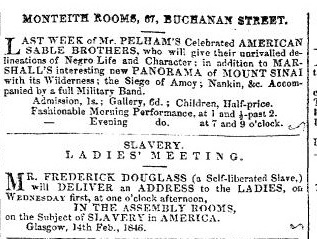
Douglass’ remarks have been taken up by modern scholars, recognising them as a key early theorisation of African American music:
His insights on the social implications of slave music should be of lasting interest to artists and intellectuals at the highest reaches of American life. More precisely, he finds that gloom and cheer, when united simultaneously, create the sound of the blues.[4]
But Douglass did not only write about music, he was himself a musician.
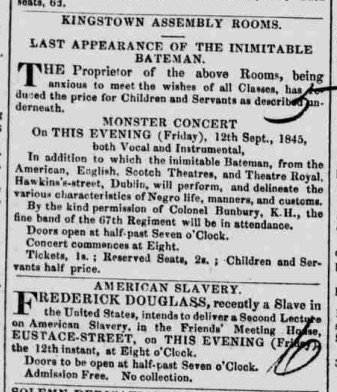
His accomplishment as a singer attracted attention. At an anti-slavery soiree at the Philosophical Rooms, Limerick on 21 November 1845, which featured speeches, tea, and tunes from the St John’s Temperance Band, after a round of toasts, ‘Mr Douglass then sang a beautiful sentimental air’.[5]
There is no indication of what this song was, but at a temperance meeting in Cork the previous month the singer John Donovan welcomed Douglass with ‘“Céad Míle Fáilte” to the Stranger’, specially composed by local poet Daniel Casey to the tune of ‘Old Dan Tucker’.[6]The distinguished guest ‘was so moved that he sang unsolicited with great effect, and power, a noble Abolition song’ to the same tune.[7] This was almost certainly ‘Get Off the Track’ written by his friends The Hutchinson Family Singers, who had accompanied Douglass across the Atlantic that August. Their song was itself a parody of the campaign song of 1844 presidential candidate Henry Clay, ‘Get Out of the Way!’[8] In doing so, Douglass offered a polite acknowledgement of the welcome offered him, while diplomatically transforming the mood of the occasion from one of self-congratulation to passionate anti-slavery commitment.
Such subtlety was not always appreciated. That Douglass’ song was met with ‘infinite amusement’, according to one report, suggests the novelty of the performance was what struck the audience most.[9] Another report, referring to a similar occasion the week before, noted merely that he ‘sang a Nigger Song.’[10]It was as if he were no more than a blackface minstrel like W. H. Bateman, whose tour schedule had closely entwined with his own and whose presence in Limerick prompted Douglass to remark that ‘he was sorry to find that one of these apes of the negro had been recently encouraged’ there, even if ‘the reptile was only supported by those of his own kind.’[11]
And as the only exposure to ‘Negro melodies’ for most of his audiences would have been the caricatures purveyed by white blackface performers, when Douglass sang on stage he ran the risk of being seen as just like them rather than disrupting their expectations. Even the Hutchinsons allowed the sheet music for ‘The Fugitive’s Song’ to be adorned with Douglass pictured like the ‘runaway slave’ one found in newspaper notices.[12]He was not likely to have been impressed, for he refused to reproduce the the stock images when he reprinted runaway notices in his newspaper the North Star: ‘We have no such figures nor prints in our office, to enable us to follow copy; but the reader must supply them for himself.’[13]
Perhaps this is why he seemed to stop singing on stage after that. There is no evidence he did during the rest of his tour of Britain and Ireland over the next 18 months, though he did sing in private, for example at the London home of the Chartist sympathiser John Humffreys Parry, where Douglass, ‘who had a fine voice, sang a number of negro melodies.’[14]
III
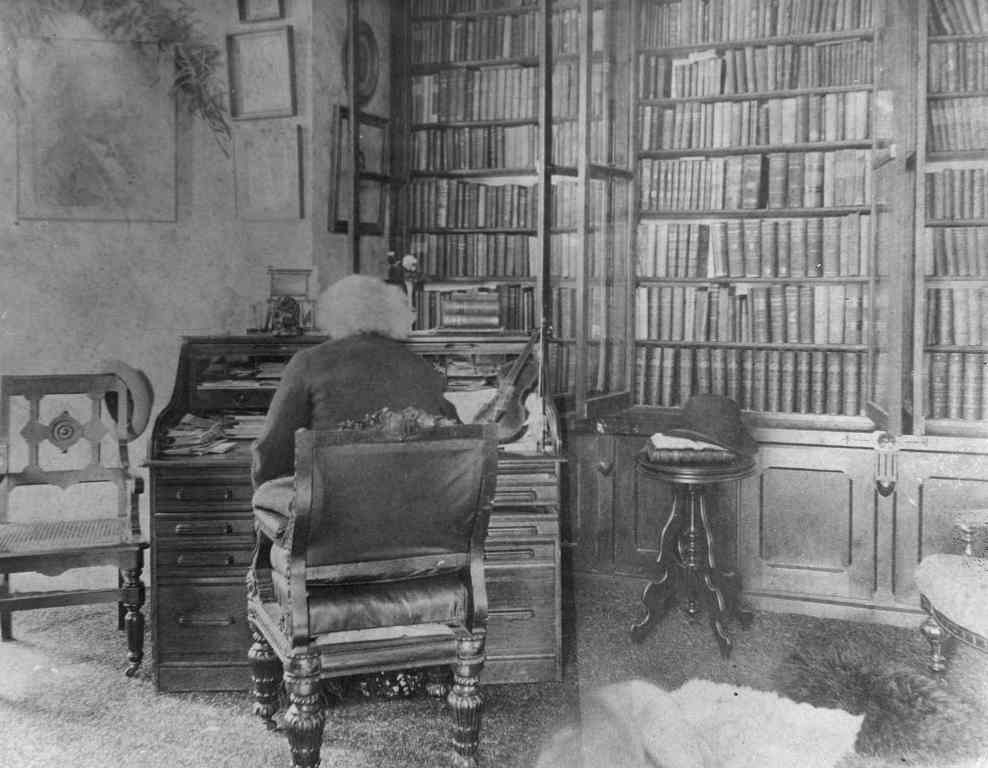
As well as a singer, Douglass was also a violinist. Pictures of him in his old age at his home at Cedar Hill in Washington show him with his instrument on his desk.
It is still in the house today, now a museum run by the National Parks Service, which identifies it as ‘Violin, c. 1891’, a copy of a Stradivarius, made in Germany, and states: ‘Douglass played the violin for his grandchildren and guests when they visited Cedar Hill.’ And indeed his grandson Joseph Douglass subsequently became a celebrated concert performer.
We don’t know when he began to learn the instrument. In his book Giants, John Stauffer makes the intriguing claim that his wife Anna – whom he met while still enslaved in Baltimore – ‘taught Frederick the violin, he was a quick study, and soon they were playing duets’.[15]As John Muller has pointed out, Stauffer’s references don’t support his claim, which must remain fanciful unless more evidence comes to light.
But Douglass did make reference in his third autobiography, The Life and Times of Frederick Douglass, to the ‘three music books’ they had in their luggage as they travelled onwards to New Bedford that followed soon after their wedding. They didn’t have the fare for the coach and the driver took the books as collateral until they could borrow the money to pay him.The books he recalled were ‘two … collections by Dyer, and one by Shaw.’[16]
Stauffer identified the latter as The Baltimore Collection of Church Music (c. 1832). And one of the Dyers must be his Third Edition of a Selection of Upwards of Eighty Favourite and Approved Anthems, Set Pieces, Odes and Choruses (1834), a copy of which is listed in the catalogue of Douglass’ library at Cedar Hill, and therefore kept safe over five decades.[17] A friend of the family, in an article on his domestic life in the 1880s, wondered if the ‘music book … on his wife’s piano at Cedar Hill’ (referring to Douglass’ second wife, Helen Pitts) was the ‘very same’ as the one ‘he slipped into his bundle when he skipped out of Maryland.’[18]
Very likely it was. None of this establishes how he came to learn the violin or who taught him, but it is clear that he (and possibly Anna) could read music as young adults and treasured their collections of hymn tunes. He was certainly a proficient instrumentalist by the time he toured Scotland. In Edinburgh in May 1846 he wrote to Ruth Cox, the friend he called ‘Harriet’ who lived with the family in Massachusetts, telling her how he ‘got real low spirits a few days – ago – quite down at the mouth. […] There was no living for me.’ And he goes on to tell her what he did.
I went down the street and saw in the window of a large store – and old fiddle. The thought struck me – it has been so long since I played any that it might do me some good – you know when I get hungry at home I always play. Well I bought the fiddle[.] [G]ave a trifle for it – brought it to the Hotel, an struck up the ‘Camels a coming.’[.] I had not played ten minutes before I began to feel better and – gradually I came to myself again and was lively as a tikis and as loving as a lamb. But Hatta. It is a terrible feeling and I advise every body to keep clear of it who can – and those who can[‘]t to buy a fiddle.[19]
Now Douglass writes the name of the tune he played as ‘The Camels a[re] Coming.’ David Blight in his 2018 biography of Douglass suggests that this must have been an old evangelical song.[20] If so, it’s a song that has left no trace in the print culture of the nineteenth century. It seems much more likely that it’s a slip for the well-known Scottish tune, ‘The Campbells are Coming’.
Douglass had been in Scotland more than six months by that time and judging by references in his speeches, was well attuned to the country’s history and literature. And indeed, the first book he bought after his escape from slavery was an edition of the Works of Robert Burns, the inscribed copy now housed at the University of Rochester, New York. A memoir of Douglass by Henrietta Vinton Davis in 1917 recalls how – in later years – he
would take up his violin and play the sweet Scotch airs of “Bonnie Mary of Argyle,” “Within a Mile of Edinboro’ Town,” “Annie Laurie,” “Put on Your Bonnets of Blue, Laddies,” etc. He would tell us of the good, warm hearted Scotch people and how they paid for his freedom.’[21]
Blight has Douglass buy his violin in London.[22] But the letter is dated 16 May and he did not arrive in London until 18 May.[23]
In later life, Douglass remembers the episode differently. In a dispatch from Rochester, NY by I. D. Marshall, published in several newspapers, the journalist recorded interviewing a certain J. K. Post who said that Douglass told him this story:
“I went into a music store in Dublin and asked to look at violins. The proprietor handed me one with seeming reluctance. He appeared to be afraid that I would break it. His whole attitude was one of amazement. He had heard of negroes, no doubt, but very likely I was the first one he had actually seen. I took the instrument from his hand and played the ‘Rocky Road to Dublin.’ He was speechless for a moment or two. Then he ran to the door connecting the shop with the living room and called to his wife.
“‘Norah! Norah!’ he cried, ‘come here! There’s a naygur here playin the fiddle. Come quick!’
“So Norah came and stood by her husband quite as amazed as that individual. Then I played ‘The Irish Washerwoman,’ and they danced for me. Then I asked the price of the violin, for I liked it. But the dealer snatched it out of my hand.
“‘It’s not for sale, sorr. Money won’t buy it.’ Then he turned to his wife and said, ‘The naygur played on that fiddle, and we’ll kape it.’
“He sold me another violin, though, really a much better one, for half a crown, but I did not play upon this instrument. I did not want him to conclude that he must keep it also because a ‘naygur’ had played on it.”
Marshall concludes:
Mr. Douglass may not play the violin now, but during those times which he always speaks of ‘as trying men’s souls’ his violin was one of his chief solaces. He has a grandson now, of whom he is very fond, to whom has descended the musical faculty, and who has shown so much talent as a violinist that he is to be sent abroad in order that his musical education may be finished.[24]
And there is another variant which has Douglass recalling he bought the violin in London (as Blight claims):
‘We were passing through the Passage de Choiseul one evening, feasting our eyes on the rare books that abound in the little shops when Mr. Douglass espied a second-hand violin exposed for sale in one of the windows. We entered, he asked the price of the instrument, looked at it carefully, twanged the strings and, as we went out, thanked the merchant for his politeness. “Why, do you know anything about the violin?” I asked of Mr. Douglass. “Certainly,” was his reply; “I have a good violin at home and often play on it. I must tell you the first time I ever took up this instrument. It was during my sojourn in London directly after my escape from slavery. I was in very low spirits, and I was walking the streets of the vast English capital in a most dejected mood, I noticed a violin in a shop window just as I did that one moment ago. In the former instance, however, I purchased the instrument, returned to my hotel, where I remained four days, shut up in my room, striving to become familiar with my new friend. And when I came forth again, I had played myself in tune.”’[25]
Edinburgh, Dublin, London. Which one was it? Edinburgh seems more likely, given the letter he wrote at the time. The other two can no doubt be put down to the fallibility of long-term memory.But Douglass never missed an opportunity to make the most of an anecdote. Perhaps he wanted to make sure that the extent of his travels of 1845-47 were more fully represented in the stories he told. And thus, in each re-telling, substituted one capital city for another.
[1] Frederick Douglass, Narrative of the Life of Frederick Douglass, an American Slave (Dublin: Webb and Chapman, 1845), 13–14, repr. in Frederick Douglass, Autobiographies (New York, Library of America, 1994), 24.
[2] Douglass, Narrative, 15, repr. in Douglass, Autobiographies, 24.
[3] Frederick Douglass, ‘The Hutchinson Family. – Hunkerism.’ North Star, 27 October 1848. For an analysis of Douglass’ attitudes to blackface performance see Tavia Nyong’o, The Amalgamation Waltz: Race, Performance and the Ruses of Memory (Minneapolis: University of Minnesota Press, 2009), 123–24.
[4] Sterling Stuckey, Slave Culture: Nationalist Theory and the Foundations of. Black America, 25th anniversary edition, (Oxford: Oxford University Press, 2013), xvii.
[5] Limerick Reporter, 25 Nov 1845.
[6] For more details on this and other poems and songs written to celebrate Douglass’ tour of Britain and Ireland in 1845–47 see Laurence Fenton, ‘Céad Míle Fáilte to the Stranger’. In my book – Frederick Douglass and Scotland, 1846: Living an Antislavery Life (Edinburgh: Edinburgh University Press, 2018), 210 – I wrongly stated that ‘Céad Míle Fáilte to the Stranger’ was composed by Donovan himself.
[7] Cork Examiner, 29 October 1845; Southern Reporter and Cork Commercial Courier, 30 October 1845.
[8] See Scott Gac, Singing for Freedom: The Hutchinson Family Singers and the NIneteenth-Century Culture of Reform (New Haven: Yale University Press, 2007), 179–81.
[9] Southern Reporter and Cork Commercial Courier, 30 October 1845.
[10] Cork Examiner, 24 October 1845.
[11] Limerick Reporter, 11 November 1845. I have been unable to discover much about Bateman. However, the Mitchell Library in Glasgow has a playbill for the Theatre Royal Adelphi (April 1844) advertising an evening ‘for the benefit of Mr. W. H. Bateman’ in which he ‘will give his last New Negro Song, called “De Light Banjo!” accompanying himself on the Banjo. He will also give his “Most Laughable Lecture on Phrenology” as given by him with tremendous applause and shouts of laughter at the Teetotal Concerts, City Hall.’ The blurb on the page says ‘Black entertainers had a particular fascination for Victorian audiences and W.H. Bateman was one of the best known of his day’. He is undoubtedly the entertainer criticised by Douglass in Ireland. But he certainly wasn’t black.
[12] On the iconography of the runaway slave see Marcus Wood, Blind Memory: Visual Representations of Slavery in England and America, 1780–1865 (Manchester: Manchester University Press, 2000), 78–142.
[13] North Star, 22 February 1850. For a fuller discussion see Sarah Blackwood, ‘Fugitive Obscura: Runaway Slave Portraiture and Early Photographic Technology’, American Literature 81.1 (2009), 99–125 (102-6).
[14] William Lovett, Life and Struggles of William Lovett [1876] (London: MacGibbon & Kee, 1967), 268.
[15] John Stauffer, Giants: The Parallel Lives of Frederick Douglass and Abraham Lincoln (New York: Twelve, 2008), 71.
[16] Frederick Douglass, Life and Times of Frederick Douglass, Written by Himself (Boston: De Wolfe & Fiske Co.,1892), 254.
[17] William L. Petrie, ed., Bibliography of the Frederick Douglass Library at Cedar Hill (Fort Washington, MD: Silesia Companies, 1995), 227. The other collection may have been Dyer’s Philadelphia Selection of Sacred Music (Philadelphia: J. G. Auner, 1828) or A New Selection of Sacred Music (Baltimore: Joseph Robinson, 1820).
[18] Jane Marsh Parker, ‘Frederick Douglass: Something About His Home Life at Rochester, N.Y.’ Salt Lake Evening Democrat, 23 April 1887.
[19] Frederick Douglass to Ruth Cox, Edinburgh, 16 May 1846 in John McKivigan, ed., The Frederick Douglass Papers. Series Three: Correspondence, Volume 1: 1842–52 (New Haven: Yale University Press, 2009) 125. The episode is alluded to by one of Douglass’ first biographers, who emebellishes as follows: he ‘shut himself up, played for three days until he was in tune himself and again went out into the world – a cheerful man’ – James M. Gregory, Frederick Douglass The Orator, (Springfield Mass: Willey & Co, 1893), 211.
[20] David Blight, Frederick Douglass: Prophet of Freedom (New York: Simon & Schuster, 2018), 156. Blight says it’s ‘a song likely based on Genesis 24, the story of how Rebekah brought water from the well for the men and camels and became the wife of Abraham’s son Isaac.’ And in a footnote he defends his claim: ‘Editors of Douglass Papers suggest the song “Camels a Coming” was a Scottish jig, “The Campbells Are Coming,” adapted by Robert Burns. But there is little reason for Douglass to assume Harriet would know that tune. It just as easily could have been some variation on the biblical story Genesis 24:60–63. “And they blessed Rebekah, and said unto her, Thou art our sister, be thou the mother of thousands of millions, and let thy seed possess the gate of those which hate them. / And Rebekah arose, and her damsels, and they rode upon the camels, and followed the man: and the servant took Rebekah, and went his way. / And Isaac came from the way of the well La-hai-roi; for he dwelt in the south country. / And Isaac went out to meditate in the field at the eventide: and he lifted up his eyes, and saw, and, behold, the camels were coming.”’
[21] Henrietta Vinton Davis, ‘Sunny Side of Douglass’ Life: How the Noted Orator Enjoyed Home Comforts. Was Great Lover of Music,’ Baltimore Afro-American, 24 Feb 1917.
[22] Blight, Douglass, 156.
[23] In a letter to William Lloyd Garrison from London on 23 May, Douglass wrote: ‘I arrived here from Edinburgh, on the 18th instant’ (Frederick Douglass Papers 3.1, 127)
[24] ‘He Preached Then. Early Career of Fred Douglass, Orator and Reformer,’ Wichita Daily Eagle, 24 Nov 1894.
[25] Theodore Stanton, ‘Frederick Douglass in Paris’, The Open Court 28 April 1887, 152.