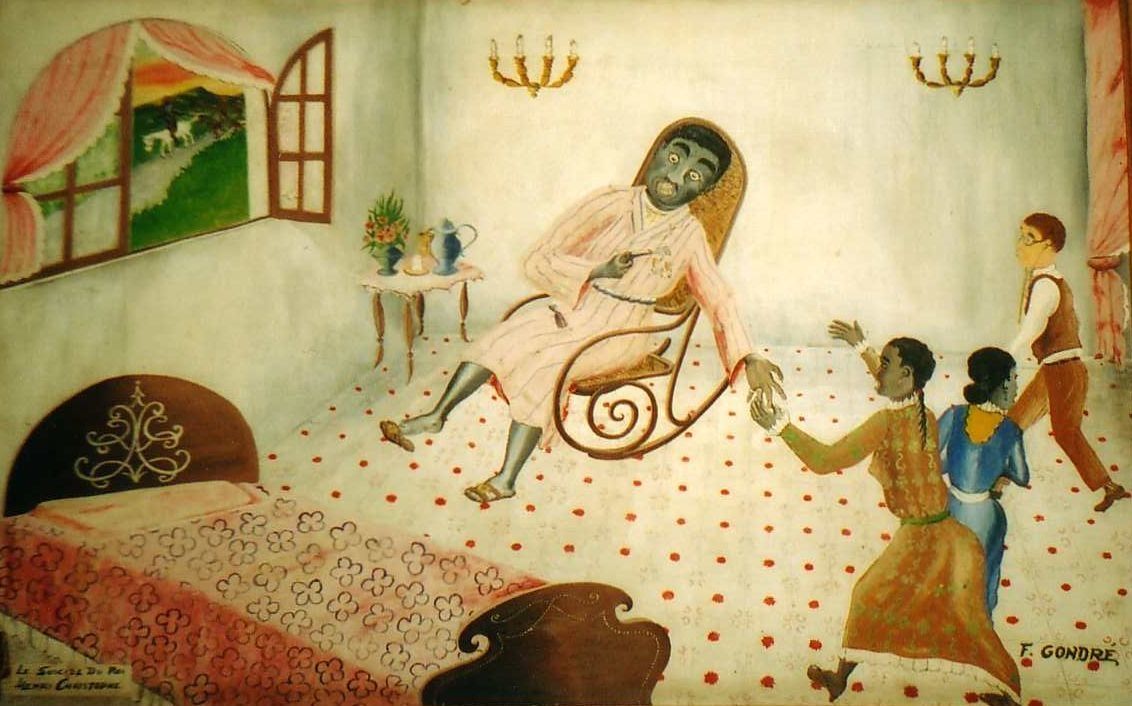
As Haiti and Scotland prepare to meet in the men’s football World Cup on Saturday (or early Sunday morning on this side of the Atlantic), it might be a good time to remember another time representatives of the two countries came together on a historic occasion.
The painting here is by the Haitian artist François Gondre and entitled ‘Le Suicide du roi Henry Christophe’.[1] In 1820, King Henry, already weakened by a stroke, and sensing that the end of his reign was nigh, as his own soldiers were defecting to the rebel army, took his own life, allegedly shooting himself with a silver bullet. What is interesting about Gondre’s version is that he includes in the scene his Scottish physician, Duncan Stewart, who was appointed professor of anatomy and surgery earlier that year, clearly identifiable with his pale complexion and distinctly red hair.
A more recent encounter was when the Haitian writer and artist Franketienne visited Scotland in 2014, organised by Rachel Douglas of Glasgow University, author of a fine study of his work, Franketienne and Rewriting (2009). A highlight for me was his readings from Rapjazz (2011) accompanied by Mark Mulholland.
Hugh MacDiarmid once wrote: ‘Scotland is not wholly surrounded by the sea – unfortunately’. He might have said the same about Haiti, another country that shares an island with a neighbour, not always harmoniously.
When I visited Haiti for the celebrations of the bicentenary of independence on 1 January 2004, I remember telling my hosts that the tune that a band was playing in a bar down the street was ‘Auld Lang Syne’, and where I lived everyone would be singing it at midnight. I made a stab at Burns’ lyric. They had no idea.
The next day I was chatting to a young woman visiting the family. She was studying in the Dominican Republic. I asked her what it was like there, grabbing my notebook and pen. ‘Wout yo se pi bon,’ she said simply. The roads are better.
Or, as Sorley Maclean put it, ‘Tha na rathaidean nas fhearr’, responding to news of the completion of the Preston By-Pass in 1958. Just kidding. But in his epic poem An Cuilithionn (1939) he did namecheck Toussaint Louverture in a list of revolutionary heroes in Part VII:
Air na sgurrachan mun cairt,
bha na beò-mhairbh a thug buaidh:
Toussaint, Marx, More, Lenin,
Liebknecht, Connollaigh, MacGill-Eain
agus iomadh spiorad àrdain
a chuireadh às an càs na Spàinne.
On the peaks around
were the living dead and their triumph:
Toussaint, More, Lenin, Marx,
Liebknecht, Connolly, Maclean,
and many a proud spirit
extinguished in the extremity of Spain.[2]
In my head I hear Haitian football fans singing ‘Yes, Sir, I can Boogie‘, while the Tartan Army chants ‘Grenadye alaso‘. It might happen.
[1] Photographed by me on a visit to the Musée d’art haitien in Port-au-Prince in January 2004. The gallery was badly damaged in the 2010 earthquake and I have not been able to ascertain whether this painting survived.
[2] Somhairle MacGill-Eain / Sorley MacLean, An Cuilithionn 1939 and Unpublished Poems, ed. Christopher Whyte. Glasgow: Association for Scottish Literary Studies, 2011, 103.